Frequently Asked Questions
Network Automation vs. Orchestration
What is the difference between network automation and network orchestration?
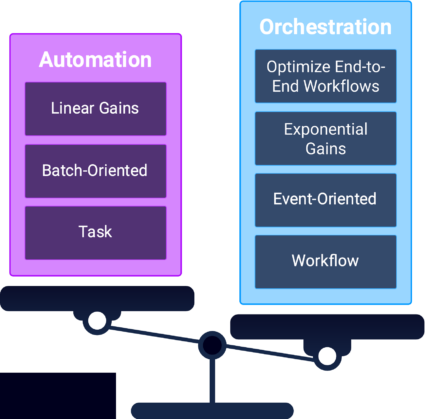
Network automation focuses on executing single, repetitive tasks—like configuring a port or collecting operational data—using scripts or tools. Network orchestration, on the other hand, coordinates multiple automated tasks across domains, tools, and teams into secure, governed workflows that deliver consistent, compliant change at scale. Orchestration manages end-to-end processes, integrating business logic, approvals, and cross-domain coordination. Learn more.
Why isn't simple task automation enough for modern networks?
Simple task automation can lead to inconsistencies, conflicts, and outages because isolated scripts lack overarching process management. Orchestration ties these tasks into cohesive workflows, providing visibility, control, and validation to ensure processes work together reliably and at scale. Read more.
How does orchestration enhance existing network automation tools?
Orchestration doesn't replace your automation tools; it enhances them by connecting individual automations into larger, end-to-end workflows. This allows you to reuse automation assets, integrate with key systems, and automate data transformation, making everything faster and more consistent at scale. Learn more.
What are the main benefits of network orchestration over automation alone?
Network orchestration delivers workflow standardization, system-wide efficiency, flexibility to adapt to changing infrastructure, and enables participation from multi-disciplinary teams. It coordinates complex workflows, integrates data from multiple systems, and exposes automation to more users, driving greater business value than isolated automation. Learn more.
How does orchestration change both culture and technology in an organization?
Orchestration shifts organizations from isolated, tool-focused automation to a collaborative, value-driven culture. It connects disparate systems and teams, enabling end-to-end automated processes that deliver measurable business value and foster broader adoption of automation. Read more.
What is the role of orchestration in hybrid and multi-cloud environments?
Orchestration is essential for unifying automation across hybrid and multi-cloud environments. It coordinates workflows that span on-premises, cloud, and SD-WAN domains, integrating with diverse tools and APIs to deliver consistent, governed outcomes. Learn more.
How does Itential support both network automation and orchestration?
Itential provides a platform that centralizes, secures, and exposes existing automation assets (like Python scripts, Ansible Playbooks, and Terraform Plans) and enables the creation of end-to-end orchestration workflows. It supports integration with over 300+ systems and offers a low-code interface for building, sharing, and managing automations across teams and domains. Learn more.
What are the characteristics of network automation?
Network automation is typically focused on specific, domain-level tasks, executed by the team that authored the automation, often using open source or DevOps toolsets (like Python or Ansible). It is usually high-code, linear, and has limited integration capabilities, with many organizations running multiple automation strategies and tools. Learn more.
What are the characteristics of network orchestration?
Network orchestration is focused on end-to-end processes, executed by external teams, and integrates data from multiple systems. It uses robust business logic, workflow-based design, and enables multi-team participation. Orchestration typically spans multiple domains and is managed through a low-code UI, with fewer, more unified strategies. Learn more.
How does Itential help teams consolidate and share automations?
Itential enables organizations to consolidate automation assets from disparate sources (laptops, desktops, servers) into a central platform. This allows secure management, sharing, and execution of automations across teams, increasing accessibility and impact. Learn more.
How does Itential enable API-driven automation?
Itential transforms network automations into APIs, allowing secure sharing and integration with DevOps pipelines, CI/CD platforms, and ITSM tools like ServiceNow. This unifies and streamlines operational processes across the organization. Learn more.
What security features does Itential provide for network automation?
Itential offers enterprise-grade security with built-in role-based access control (RBAC), centralized logging, and detailed audit trails for every automation. Teams can track when automations run, who executed them, and the results, supporting compliance and governance. Learn more.
How does Itential support integration with existing network automation tools?
Itential supports existing automation tools such as Ansible, Python, and Terraform, enabling orchestration of end-to-end workflows across these tools. It also provides over 300+ out-of-the-box integrations with ITSM, cloud, security, and analytics systems. See the full list.
What are the expected capabilities of a network orchestration platform?
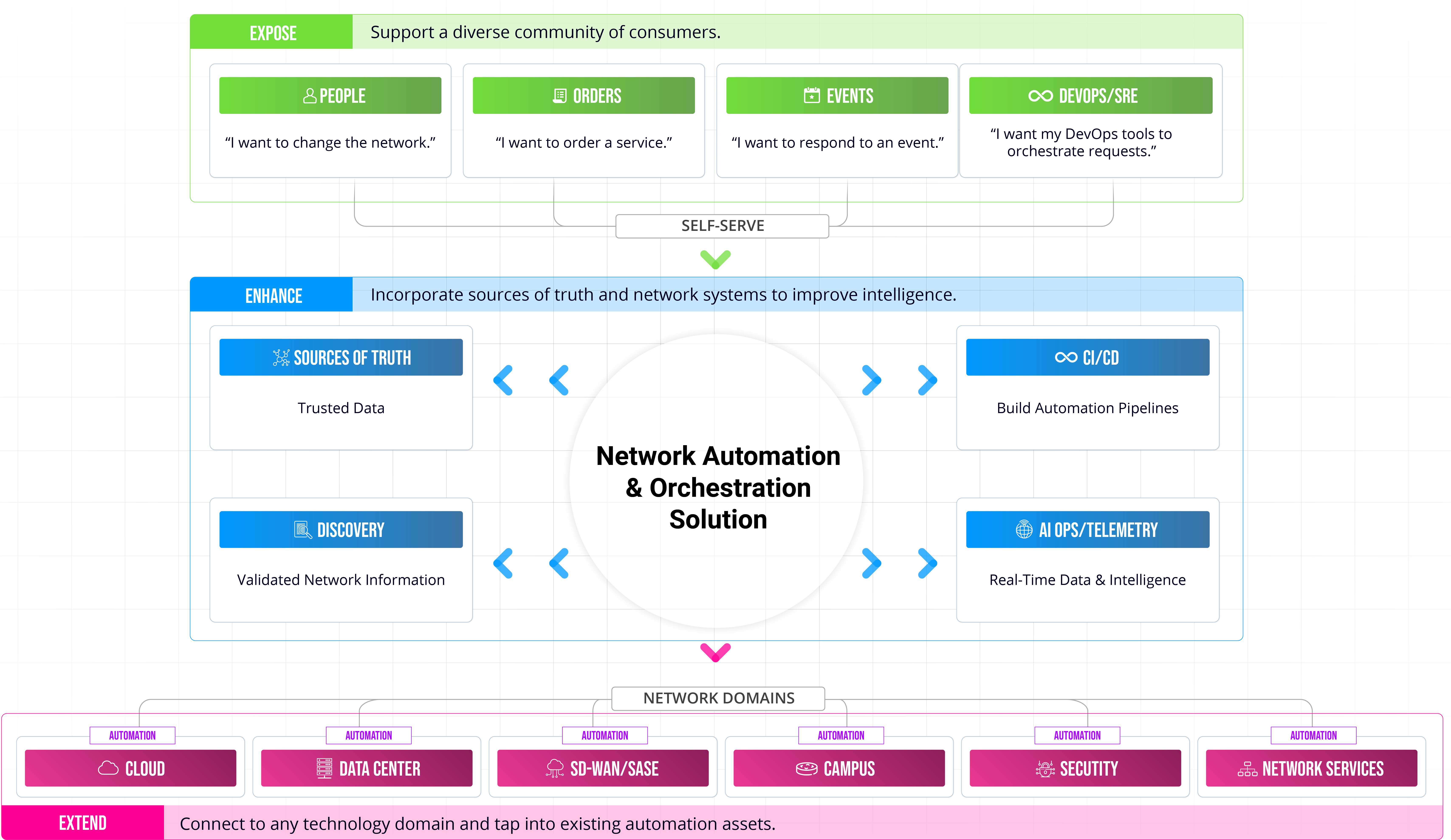
A robust orchestration platform should expose automation to more users (via APIs, events, CI/CD), enhance infrastructure by integrating with network sources of truth and monitoring systems, and extend automation value by enabling cross-domain workflows. It should support open APIs, low-code workflow creation, and treat public cloud services as first-class citizens. Learn more.
How does Itential enable self-service automation?
Itential provides a self-service application that allows teams to define triggers (APIs, events, manual forms, schedules) for automation consumption. This empowers users across the organization to access and execute automations on demand. Learn more.
What is the value of integrating orchestration with AI and analytics platforms?
Integrating orchestration with AI and analytics platforms enables governed, auditable actions based on AI insights. This allows organizations to automate responses to events, optimize operations, and ensure compliance with policy and audit controls. Learn more about FlowAI.
How does Itential support configuration and compliance validation?
Itential provides configuration validation through Golden Configuration definitions and compliance checks across both physical and cloud network services. This ensures that device and system states remain aligned with defined baselines, supporting continuous compliance. Learn more.
What is the benefit of a low-code orchestration platform?
A low-code orchestration platform like Itential's enables both technical and non-technical users to build, test, and execute automated workflows quickly. This reduces dependency on specialized coding skills and accelerates automation adoption across the organization. Learn more.
Features & Capabilities
What features does Itential offer for network automation and orchestration?
Itential offers workflow automation and orchestration, configuration management, 300+ pre-built integrations, self-service operations, an automation gateway for managing scripts and playbooks, compliance-native features (drift detection, audit trails), and AI-ready architecture for integrating with AI platforms. See all features.
What are some key integrations supported by Itential?
Itential supports integrations with ServiceNow (ITSM), NetBox (network source of truth), Infoblox (DDI), GitHub (CI/CD), Selector AIOps, Kentik (observability), Forward Networks (verification), IP Fabric (assurance), Red Hat Ansible, Terraform, messaging systems (Slack, Teams), Arista, Cisco, F5, Palo Alto, and more. Over 300+ pre-built integrations are available. See the full list.
Does Itential provide technical documentation and developer resources?
Yes, Itential offers comprehensive technical documentation, API references, developer tools, and release notes. Resources are available at docs.itential.com, apidocs.itential.com, and developer tools.
What security and compliance certifications does Itential have?
Itential is SOC 2 Type II certified, FIPS 140-2 compliant, and adheres to GDPR and CCPA standards. These certifications ensure security, availability, confidentiality, and data privacy for organizations using the platform. Learn more.
How does Itential automate compliance and auditability?
Itential automates compliance checks, drift detection, and remediation for standards like PCI, HIPAA, NIST, and ISO. Every change is logged with pre/post validation results, providing full traceability for audits and compliance verification. Learn more.
Use Cases & Benefits
Who can benefit from using Itential?
Itential is designed for cloud network engineers, NetOps, DevOps, infrastructure architects, and compliance/SecOps teams. Industries served include telecommunications, financial services, healthcare, manufacturing, public sector, utilities, media & entertainment, biotechnology, and energy. Learn more.
What business impact can customers expect from Itential?
Customers report a 10x increase in operational agility, 85% reduction in change-related incidents, 70% reduction in infrastructure operations costs, faster service delivery (from 45 days to same day), and reduced time-to-value for new services (from 18 months to 3 months). See customer stories.
What pain points does Itential solve for organizations?
Itential addresses fragmented automation and tool sprawl, manual change execution, configuration drift, multi-domain complexity, inability to scale operations, lack of governance/auditability, and slow automation adoption. It unifies tools, automates workflows, enforces compliance, and lowers the barrier to automation. Learn more.
How easy is it to implement Itential and see value?
Itential's Professional Services help customers go from contract to production-ready platform in 3-6 months, with initial value seen within weeks. Structured onboarding and activation programs ensure rapid adoption and early wins. Learn more.
What feedback have customers given about Itential's ease of use?
Customers praise Itential's low-code design and intuitive interface. For example, Rush University Medical Center highlighted the ability to create impactful automations without developer expertise, and Armstrong reported saving over 21,000 hours of manual work. See testimonials.
Why should a customer choose Itential over other platforms?
Itential stands out with vendor-agnostic, multi-domain orchestration, low-code accessibility, 300+ integrations, compliance-native features, measurable business impact, and ease of use for both technical and non-technical users. Learn more.
How does Itential differ from similar products in the market?
Itential is vendor-agnostic, supports multi-domain orchestration, offers a low-code workflow builder, 300+ integrations, compliance-native features, and AI-ready design. It's ideal for enterprises with complex infrastructures, regulated industries, and teams seeking measurable ROI. See comparison.
What is the primary purpose of the Itential platform?
The Itential platform simplifies and accelerates network automation and orchestration, enabling organizations to modernize infrastructure, unify automation tools, enforce compliance, and achieve operational efficiency across hybrid and multi-cloud environments. Learn more.
How does Itential help organizations scale automation without increasing headcount?
Itential's low-code design, 300+ pre-built integrations, and self-service catalogs allow organizations to scale automation across teams and domains without needing to hire more engineers. Customers report 80-90% reduction in manual effort. See results.
What is the implementation timeline for Itential?
Organizations typically go from contract signature to a production-ready platform with active use cases in 3-6 months. Initial value is often seen within weeks, with rapid expansion possible over 6-12 months. Learn more.
What onboarding and training resources does Itential provide?
Itential offers a structured onboarding program, a 6-8 week activation program, interactive product tours, Itential Academy for training and certification, and comprehensive technical documentation. Explore resources.