
Share this

Table of Contents
Some moments only make sense in hindsight.
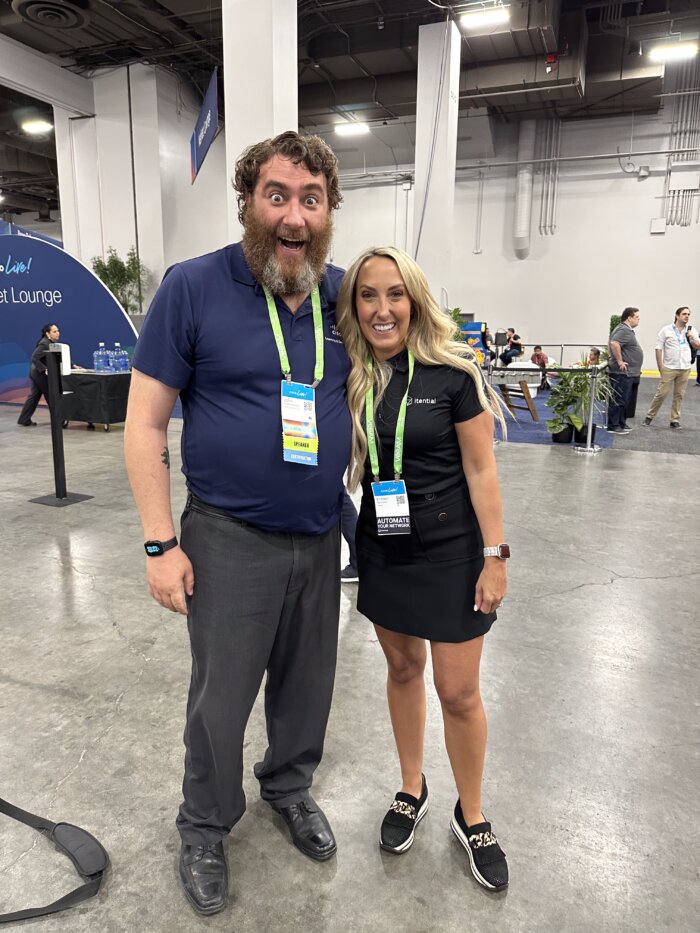
Years ago, at Cisco Live, I was walking toward the World of Solutions when I noticed something odd. Everywhere I looked – banners, signage, booths – the same phrase kept appearing:
Automate Your Network.
I remember smiling to myself and thinking, “Wow… somebody really enjoyed my book.”
As I continued walking, about 200 yards out with nobody between us, I noticed an incredibly excited woman waving enthusiastically in my direction. I even checked over both shoulders to make sure it was actually me she was waving at.
It was.
That person was Kristen Rachels – I didn’t know it then, but she’d eventually become a big part of why I’m joining Itential.
At the time, I couldn’t have known how aligned that moment really was. But looking back now, it feels less like coincidence and more like inevitability.
This is why my next chapter begins at Itential.
Automate Your Network Was Never Just a Slogan
When I wrote Automate Your Network, the core idea wasn’t tools, scripts, or even automation itself.
It was intent.
Automation was never the end goal – it was the mechanism. The real goal was enabling engineers and operators to express what they want to happen without being crushed under the weight of how it happens.
Over the years, I’ve watched automation adoption stall not because engineers lacked skill or motivation, but because automation at scale is brutally hard without orchestration.
Scripts don’t coordinate themselves
APIs don’t enforce governance
Playbooks don’t create repeatability across teams
Talent doesn’t scale linearly
Automation without orchestration eventually collapses under its own complexity.
This is where Itential stood out to me long before I ever joined the company.
The platform doesn’t just automate tasks – it centralizes, governs, and repeats automation in a way that enterprises can actually sustain. And critically, it makes automation accessible to people regardless of their Python, Ansible, or scripting depth.
That philosophy maps almost perfectly to the vision I’ve been talking about for over a decade.
The Timing Could Not Be More Important
Let’s ground this in reality.
- ChatGPT 3.5 is barely three years old
- Model Context Protocol (MCP) is roughly one year old
- Agent-to-Agent (A2A) communication is even newer
And yet – despite how early this all is – AI already has a proven operational track record.
This is the rare moment where something is both:
- early enough to shape
- mature enough to trust
That window doesn’t stay open long.
I strongly believe:
- 2025 was the year of MCP
- 2026 will be the year of AI Agents
Not demos.
Not chatbots.
Not “look what this model can do.”
Real agents. Doing real work. In real systems.
Flow, Flow State, & FlowAI
Developers, engineers, and creators have long talked about the flow state – that rare alignment where focus, creativity, and productivity converge. Time disappears. Friction vanishes. Output accelerates.
Most tools interrupt flow.
Itential FlowAI does the opposite.
What excites me most about FlowAI is that it allows us to bring digital beings – AI agents – into the flow state alongside human engineers.
Not to replace them.
Not to slow them down.
But to amplify them.
FlowAI augments already powerful developers by:
- absorbing cognitive load
- maintaining operational context
- handling repetitive reasoning
- coordinating deterministic execution
The result isn’t automation for automation’s sake – it’s momentum.
Why Agents Need Orchestration (& Governance)
AI agents reason dynamically.
Workflows execute deterministically.
That distinction matters.
One of the reasons I’m so excited about Itential is that it’s the first platform I’ve seen implement MCP the right way – with a strict, intentional boundary between reasoning and execution.
This separation enables something incredibly powerful:
- AI agents can evolve dynamically
- workflows remain predictable, validated, and governed
That’s not accidental, it’s foundational.
What I’m Excited to Build Next
Personally, I’m energized by two ideas I believe will define the next phase of agentic systems:
1. Context Control for AI Agents
Think version control and source control, but for:
- agent memory
- context sources
- reasoning inputs
- decision boundaries
Agents shouldn’t just reason – they should be auditable, branchable, and mergeable.
2. Automated, Dynamic Testing for Agents
Workflows are deterministic – testable by nature.
Agents are adaptive – and that breaks traditional testing models.
Instead of hand-crafted test suites and brittle templates, I’m excited about agents that:
- generate their own validation paths
- observe the impact of their actions
- test outcomes dynamically as they operate
This dramatically reduces the overhead of maintaining massive test libraries while increasing confidence and safety.
Itential’s architecture makes this possible in a way I haven’t seen elsewhere.
Finding People on the Same Wavelength
One of the strongest signals for me was the people.
I could immediately tell that William Collins, Joksan Flores, and Peter Sprygada are deeply in the flow with AI.
Same wavelength.
Same curiosity.
Same bias toward building.
When you find that kind of alignment – technically and philosophically – you lean in.
The Next Chapter
Every chapter of my career has shared a common theme: bringing awareness to powerful technology by making it approachable, practical, and real.
This next chapter is no different.
I’m excited to help shine a light on:
- what Itential has already built
- what FlowAI enables
- and what agentic automation can become when it’s done responsibly
The future of infrastructure automation isn’t scripts versus humans.
It’s humans, workflows, and agents – orchestrated together.
And that’s a future I’m incredibly excited to help build.

John Capobianco
Head of AI & Developer Relations ‐ Itential
John Capobianco is the Head of AI & Developer Relations at Itential, and a technology leader, developer advocate, and builder at the intersection of AI and network automation. With a career spanning enterprise, government, and cloud networking, John has held roles including Head of Developer Relations at Selector AI, where he focused on AI-driven observability, configuration intelligence, and autonomous network operations, as well as Cisco AI Technical Leader and Senior Network Architect for the Parliament of Canada / House of Commons. He brings deep, hands-on experience applying automation and AI in highly regulated, mission-critical environments. His work centers on helping large organizations adopt AI safely while maintaining reliability, security, and operational trust. John is a former professor at St. Lawrence College, an author, speaker, and educator. He is the author of Automate Your Network (self-published, 2019) and the Cisco Press pyATS book (2024). He regularly shares insights through talks, workshops, and the Automate Your Network brand, with a focus on practical, production-ready AI, developer empowerment, and the evolution of network engineering in an AI-first world.