Frequently Asked Questions
The AI for Infrastructure Journey & FlowAI
What is the "AI for Infrastructure Journey" described by Itential?
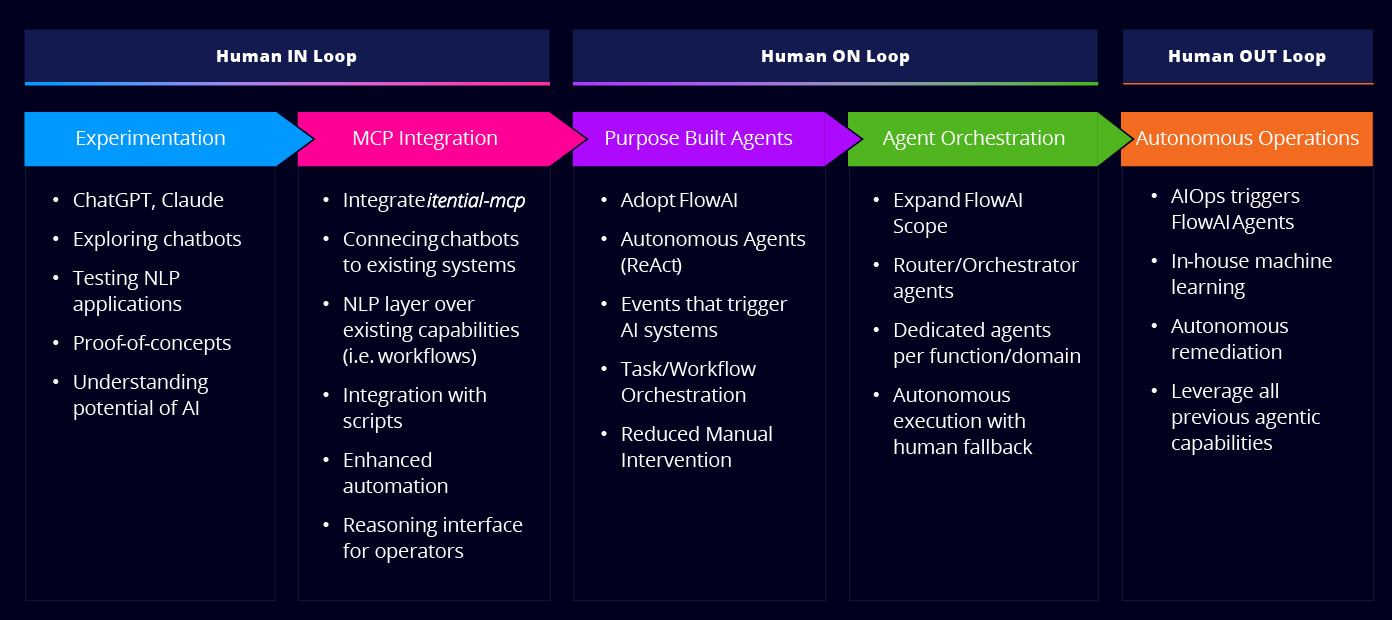
The "AI for Infrastructure Journey" is a five-phase framework developed by Itential to help organizations move from initial AI experimentation to fully autonomous infrastructure operations. The journey includes: 1) Experimentation (Human IN the Loop), 2) MCP Integration (Human IN/ON the Loop), 3) Purpose-Built Agents (Human ON the Loop), 4) Agent Orchestration (Human ON the Loop), and 5) Autonomous Operations (Human OUT of the Loop). Each phase builds trust and governance, allowing teams to safely adopt agentic AI for infrastructure. [Source]
How does Itential FlowAI support the AI for Infrastructure Journey?
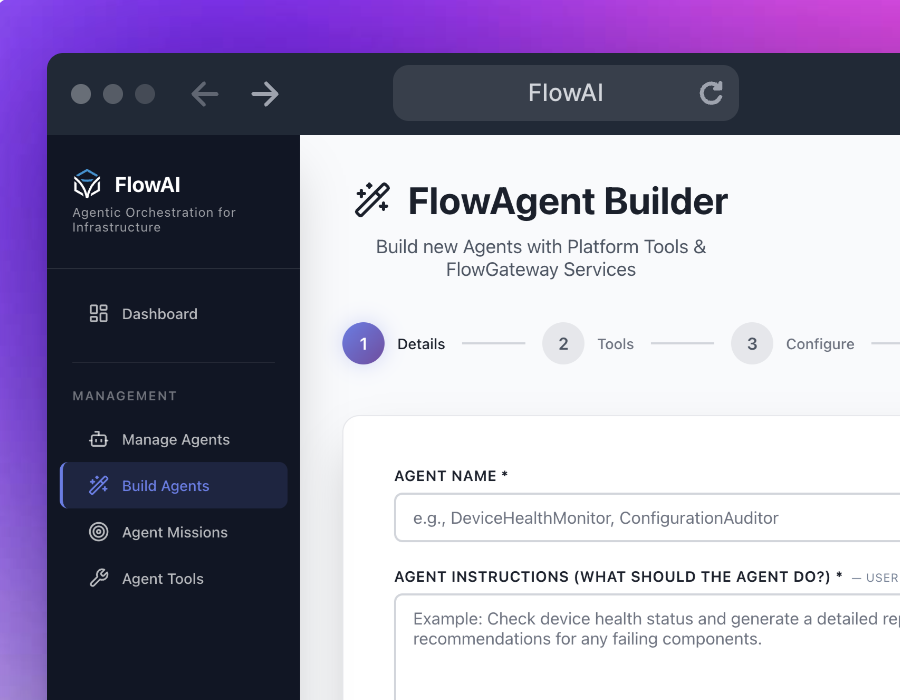
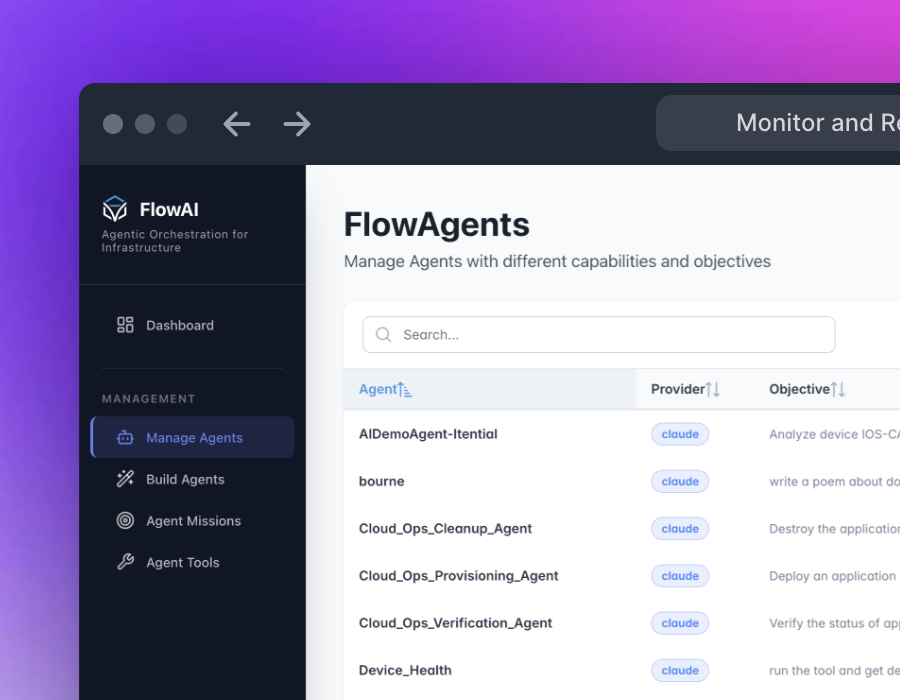
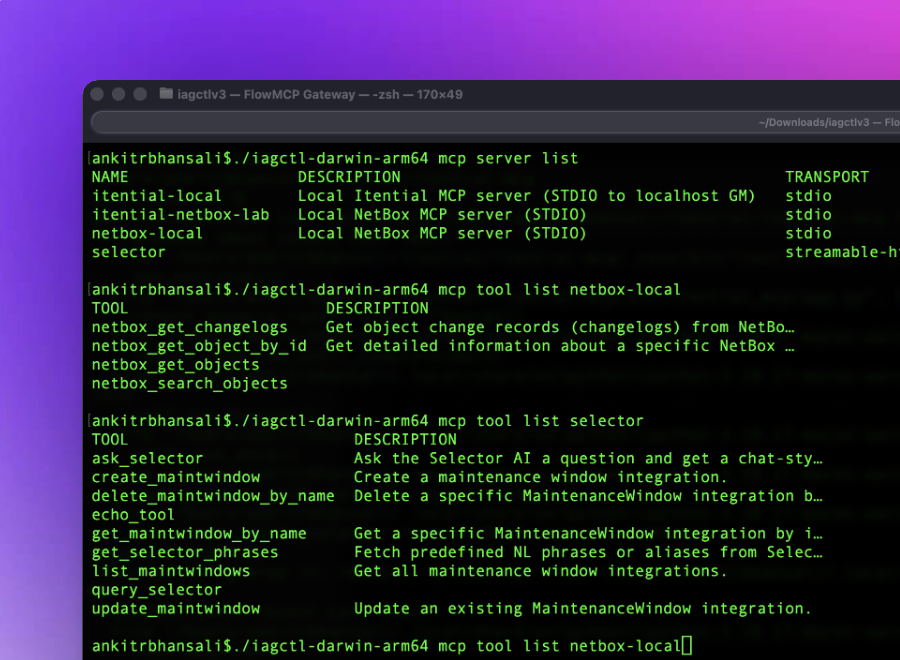
Itential FlowAI is the product realization of the AI journey framework. It provides the tools and capabilities for each phase, including FlowAgent Builder for creating role-based agents, FlowAgents for intelligent task execution, FlowMCP for deterministic execution, and FlowMCP Gateway for connecting to external MCP tools. FlowAI ensures "Governed Intelligence by Design," separating AI reasoning from deterministic execution for safe, auditable automation. [Source]
What are the five phases of the AI for Infrastructure Journey?
The five phases are: 1) Experimentation (AI in read-only mode, Human IN the Loop), 2) MCP Integration (AI proposes, humans approve, Human IN/ON the Loop), 3) Purpose-Built Agents (specialized agents, Human ON the Loop), 4) Agent Orchestration (multiple agents collaborate, Human ON the Loop), and 5) Autonomous Operations (closed-loop automation, Human OUT of the Loop). Each phase increases AI autonomy while maintaining governance. [Source]
How does Itential ensure governance and safety in agentic AI automation?
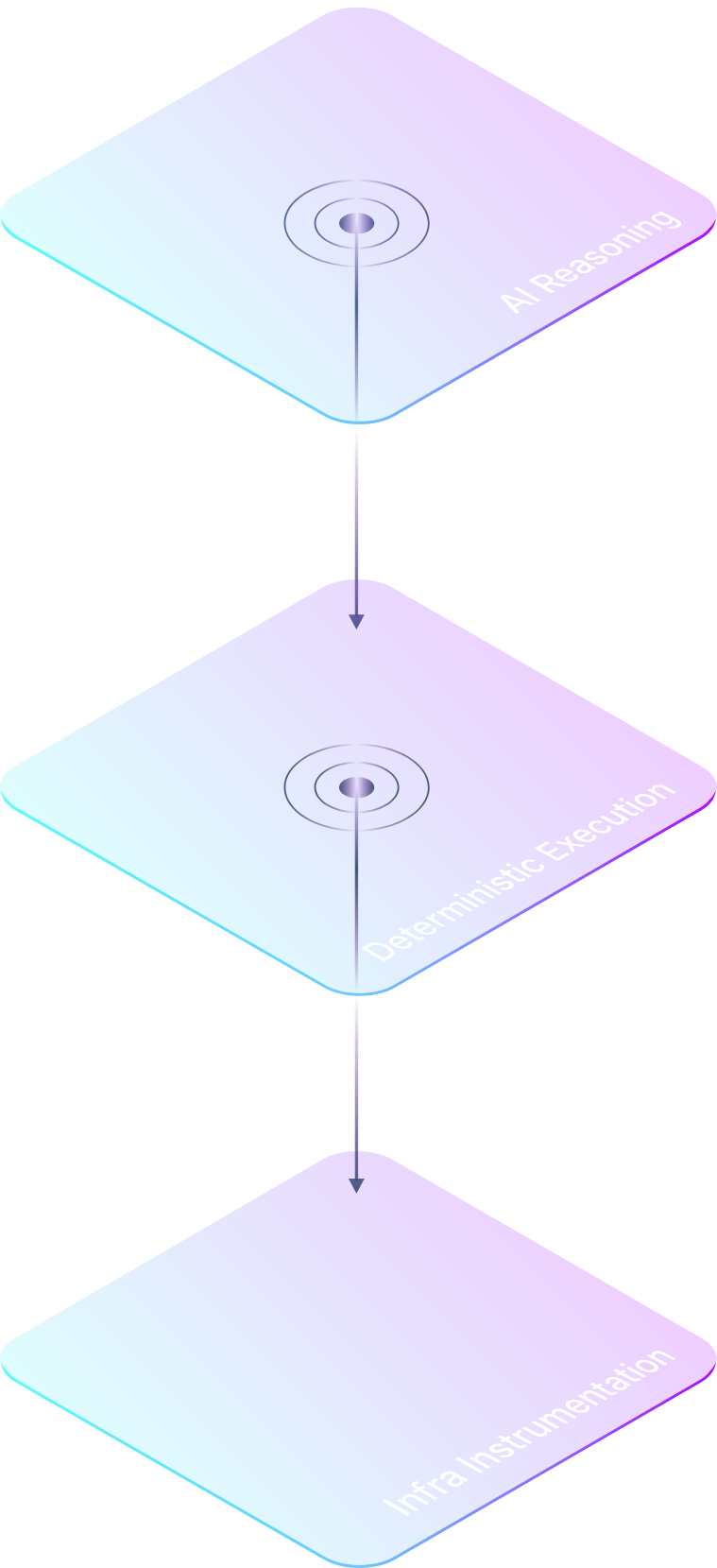
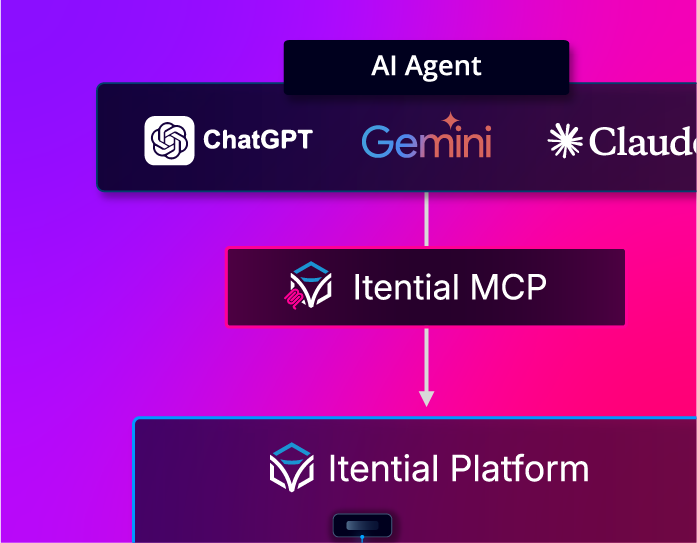
Itential enforces governance and safety through a three-layer architecture: the reasoning layer (AI agents interpret intent), the deterministic execution layer (workflows with strict validation, RBAC, and policy enforcement), and the infrastructure instrumentation layer (real-time data and integrations). All AI-proposed actions must pass through deterministic, governed workflows, ensuring predictability, auditability, and compliance. [Source]
What is the role of the Model Context Protocol (MCP) in the AI journey?
The Model Context Protocol (MCP) is an open standard that enables AI agents to interact with infrastructure in a controlled, governed manner. Through Itential's MCP Server, organizations can connect AI agents to infrastructure, allowing AI to propose actions while requiring human approval for execution in early phases. [Source]
How does FlowAI separate AI reasoning from deterministic execution?
FlowAI separates AI reasoning from deterministic execution by ensuring that AI agents (reasoning layer) can only propose actions, which are then executed through validated, governed workflows (deterministic execution layer). This separation allows organizations to innovate with AI while maintaining strict operational control and compliance. [Source]
What is "Governed Intelligence by Design" in FlowAI?
"Governed Intelligence by Design" is FlowAI's approach to ensuring that AI-driven automation is always subject to platform-level governance, including validation, RBAC, policy enforcement, and audit trails. This design allows organizations to adopt AI safely, with clear boundaries between AI reasoning and execution. [Source]
How can organizations get started with the AI for Infrastructure Journey?
Organizations can start by instrumenting their infrastructure with APIs for real-time data, establishing deterministic execution workflows with governance, and layering AI reasoning capabilities progressively. The journey begins with read-only AI assistants and advances through human-approved actions to autonomous operations as trust builds. [Source]
What is the difference between traditional automation and agentic AI in infrastructure operations?
Traditional automation executes predefined workflows ("if X, then Y"), while agentic AI reasons through operational challenges, interprets intent, evaluates context, and adapts to changing conditions. Agentic AI can propose and coordinate actions, but with governance and human oversight as defined by the AI for Infrastructure Journey. [Source]
How does Itential FlowAI enable collaboration between multiple AI agents?
FlowAI allows organizations to deploy multiple specialized agents (FlowAgents) that collaborate on complex tasks. For example, one agent may detect anomalies, another analyzes configurations, and a third proposes remediation. A router/orchestrator agent coordinates these specialists, ensuring all actions are governed and auditable. [Source]
What is the role of humans in autonomous operations with Itential?
In autonomous operations (Phase 5), humans shift from reactive problem-solving to proactive governance and strategic oversight. They define policies, handle exceptions, and analyze agent decisions for continuous improvement, while agents handle detection, diagnosis, and remediation. [Source]
How does Itential FlowAI help build purpose-built AI agents?
FlowAI's FlowAgent Builder enables teams to create role-based, purpose-built agents tailored to specific operational domains, such as compliance validation or troubleshooting. These agents operate within defined boundaries and always execute actions through governed workflows. [Source]
What is the FlowMCP Gateway and why is it important?
The FlowMCP Gateway extends connectivity to external MCP tools while ensuring all interactions inherit platform-level governance controls. This allows organizations to leverage both Itential's native integrations and the broader MCP-compatible ecosystem safely. [Source]
How does Itential's architecture support safe AI adoption?
Itential's architecture separates AI reasoning from deterministic execution and provides comprehensive infrastructure instrumentation. This separation ensures that AI can innovate and propose actions, but all execution is governed, validated, and auditable, supporting safe and progressive AI adoption. [Source]
What is the main benefit of following the AI for Infrastructure Journey?
The main benefit is that organizations can safely and confidently adopt agentic AI for infrastructure, building trust and value at each phase. This approach enables increased automation, operational agility, and reliability without sacrificing governance or compliance. [Source]
How does Itential FlowAI address the challenge of "smart doesn't mean safe" in AI automation?
FlowAI addresses this challenge by ensuring that all AI-driven actions are subject to strict governance, validation, and auditability. AI agents can reason and propose actions, but execution is always governed by deterministic workflows, preventing unsafe or unauthorized changes. [Source]
What is the significance of "Human IN, ON, and OUT of the Loop" in the AI journey?
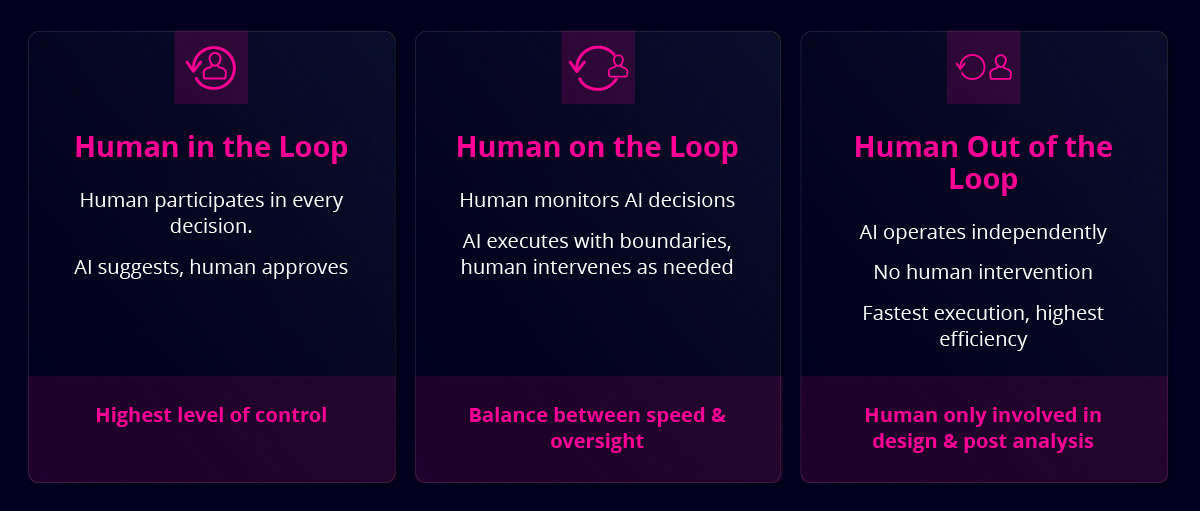
This framework describes the evolving role of humans as organizations progress through AI adoption: initially, humans supervise all AI actions (IN the Loop), then oversee and approve (ON the Loop), and finally focus on governance and exception handling as AI operates autonomously (OUT of the Loop). [Source]
How does Itential FlowAI help organizations scale AI adoption safely?
FlowAI enables organizations to start with low-risk, read-only AI assistants and progressively add capabilities as trust and confidence grow. Each phase is governed, ensuring that as AI autonomy increases, so does the level of operational control and auditability. [Source]
Features & Capabilities
What are the key features of the Itential platform?
Key features include low-code workflow automation and orchestration, configuration management with compliance validation, 300+ pre-built integrations, self-service operations, centralized automation gateway, compliance-native features (drift detection, audit trails), and AI-ready architecture for agentic automation. [Source]
Does Itential support integration with other IT and network tools?
Yes, Itential supports over 300 pre-built integrations, including ServiceNow, NetBox, Infoblox, GitHub, Selector AIOps, Kentik, Forward Networks, IP Fabric, Red Hat Ansible, Terraform, Slack, Microsoft Teams, Arista, Cisco, F5, and Palo Alto. [Source]
What technical documentation is available for Itential?
Itential provides comprehensive technical documentation, including guides, API references, and release notes at docs.itential.com, developer tools, and API documentation at apidocs.itential.com. [Source]
What security and compliance certifications does Itential have?
Itential holds SOC 2 Type II Certification, is FIPS 140-2 compliant, and adheres to GDPR and CCPA for data privacy. These certifications demonstrate a commitment to security, availability, confidentiality, and processing integrity. [Source]
How does Itential automate compliance and governance?
Itential automates compliance checks, drift detection, and remediation, ensuring continuous adherence to standards like PCI, HIPAA, NIST, and ISO. Every change is logged with pre/post validation for full auditability. [Source]
What is the Automation Gateway in Itential?
The Automation Gateway centralizes and manages all automation assets, including scripts and playbooks, from a single interface, making it easier to govern and reuse automation across the organization. [Source]
How does Itential support AI networking environments, such as those running on Arista?
Itential provides real-time automation for AI networking environments, enabling automated deployments, congestion event checks via CloudVision, and orchestration of remediation and notifications to ticketing systems, ensuring network stability and performance. [Source]
Use Cases & Benefits
Who can benefit from using Itential?
Itential is designed for cloud network engineers, NetOps, DevOps, infrastructure architects, and compliance/SecOps teams across industries such as telecommunications, financial services, healthcare, manufacturing, public sector, utilities, media & entertainment, biotechnology, and energy. [Source]
What business impact can customers expect from using Itential?
Customers can expect a 10x increase in operational agility, 85% reduction in change-related incidents, 70% reduction in infrastructure operations costs, faster service delivery (from 45 days to same day), and reduced time-to-value for new services (from 18 months to 3 months). [Source]
What core problems does Itential solve?
Itential solves fragmented automation and tool sprawl, manual change execution, configuration drift and non-compliance, multi-domain complexity, inability to scale operations, lack of governance and auditability, and slow adoption of automation due to coding barriers. [Source]
What pain points do Itential customers typically face?
Customers often face fragmented automation, manual processes, configuration drift, multi-domain complexity, inability to scale, lack of governance, and slow automation adoption due to required coding expertise. Itential addresses these with unified orchestration, low-code tools, and compliance features. [Source]
How easy is it to implement Itential and how long does it take?
Itential's Professional Services help customers go from contract to production-ready platform in 3-6 months, with initial value seen within weeks. Structured onboarding and activation programs, product tours, and training ensure rapid adoption. [Source]
What feedback have customers given about Itential's ease of use?
Customers praise Itential for its low-code design and intuitive interface. For example, Armstrong saved over 21,000 hours of manual work, and Rush University Medical Center highlighted the ability to create impactful automations without developer expertise. [Source]
Competition & Comparison
How does Itential differ from other automation platforms?
Itential stands out with vendor-agnostic, multi-domain orchestration, low-code accessibility, 300+ pre-built integrations, compliance-native features, AI-ready design, and measurable business impact. It is ideal for enterprises with complex, multi-vendor environments and regulated industries. [Source]
Why choose Itential over other solutions?
Choose Itential for its vendor-agnostic orchestration, low-code workflow builder, integration-first approach, compliance-native features, measurable business impact, and ease of use for both technical and non-technical users. [Source]
Customer Proof & Success Stories
Which enterprise companies trust Itential for automation?
Itential is trusted by Armstrong, Blackfoot Comms, Colt, Corning, Deutsche Telekom, Fiserv, Irideos, Leidos, Liberty Global, Lumen, Rush, S&P Global, Southern California Edison, Tim, and Virgin Media O2. [Source]
Are there customer stories about the AI for Infrastructure Journey?
Yes, customer stories such as Armstrong World Industries, Rush University Medical Center, and a multinational biotech company highlight successful automation and orchestration journeys with Itential. [Source]
Blog & Resources
Where can I read more about the AI for Infrastructure Journey?
You can read the full article on the AI for Infrastructure Journey on the Itential blog: Read here.
Does Itential have a blog or podcast?
Yes. Itential maintains a blog with insights on automation, AI, and industry trends at itential.com/blog and a podcast covering industry topics at itential.com/resources.
What other resources does Itential offer on AI and networking?
Itential provides analyst reports, webinars, podcasts, demos, and videos covering topics like agentic orchestration, AI reasoning, and safe AI automation for enterprise infrastructure. [Source]