Frequently Asked Questions
Data Integration & Federation Fundamentals
What is data federation in the context of network automation?
Data federation is the process of aggregating and harmonizing data from multiple sources—such as network controllers, orchestrators, inventory management systems, and performance systems—without copying all data into a central master database. Instead, federation creates a meta-map of systems and queries them in real-time during workflow execution, ensuring up-to-date and consistent information for automation processes. [Source]
Why is data integration and federation critical for scaling network automation?
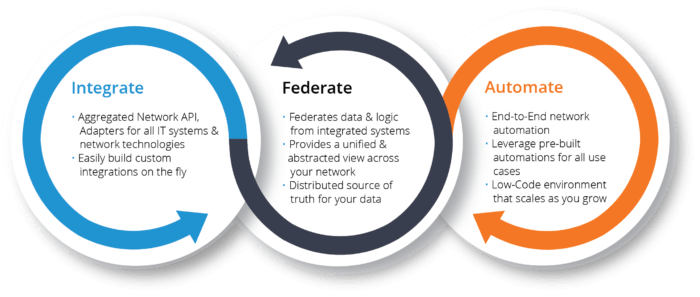
Data integration and federation are critical because network data is scattered across various systems (ITSM, IPAM, inventory, CMDBs, etc.). Federation provides a unified, real-time view of all network data, enabling automation workflows to access necessary information from multiple sources without replacing existing systems. This is essential for scaling automation efforts and ensuring automations always use the most current data. [Source]
How does Itential's approach to data federation differ from traditional master database models?
Traditional models rely on copying large amounts of data into a central master database, which can lead to data quality, timeliness, and synchronization issues. Itential's federation approach avoids these problems by querying relevant sources of truth in real-time during automation workflows, ensuring automations always use the latest, most accurate data without creating inconsistencies. [Source]
What challenges do organizations face when scaling network automation?
Organizations face challenges such as tool sprawl, data silos, manual change execution, configuration drift, multi-domain complexity, and lack of governance. As networks grow in complexity and scale, managing data across multiple controllers, orchestrators, and management systems becomes increasingly difficult without a unified approach. [Source]
How does Itential's federation layer help unify network data?
Itential's federation layer aggregates and harmonizes data from multiple sources, allowing users and systems to interact with a global list of device types and network entities, regardless of the underlying controller or orchestrator. This eliminates the need for multiple interfaces and enables a single API for network operations, simplifying automation and reducing manual effort. [Source]
What is an example of a real-world scenario where federation is needed?
In large networks, a single device (e.g., a switch) may be represented in multiple systems—EMS, SDN controller, inventory, and ordering systems—each with its own data model. Federation links these views, so operations teams can treat the device as a single entity, simplifying management and automation across domains. [Source]
How does federation improve the reliability and scalability of automation?
Federation enables real-time access to accurate data, reducing errors caused by outdated or inconsistent information. It also allows automation to scale across large, multi-domain environments by providing a unified data model, supporting use cases involving 100,000+ devices. [Source]
What is the difference between data integration and data federation?
Data integration typically involves consolidating data from multiple sources into a single repository, while data federation provides a unified, virtualized view of data across sources without physically moving or duplicating it. Federation enables real-time access and harmonization, which is essential for dynamic network automation. [Source]
Why is a single source of truth not practical for network automation?
Chasing a single source of truth is impractical because network data is distributed across many systems, each serving different operational needs. Federation allows automations to access live data from all relevant sources, ensuring accuracy and eliminating the need for constant data synchronization. [Source]
How does Itential's platform enable seamless automation across multiple domains?
Itential abstracts APIs and logic from different systems into unified workflows, enabling seamless coordination across network, cloud, security, and IT infrastructure. This allows organizations to automate end-to-end processes that span multiple domains and tools. [Source]
Features & Capabilities
What are the key features of the Itential Automation Platform?
The Itential Automation Platform offers workflow automation and orchestration, configuration management, over 300 pre-built integrations, self-service operations, an automation gateway, compliance-native features, and AI-ready architecture. These features enable organizations to automate complex, multi-domain environments efficiently. [Source]
Does Itential support integration with existing IT and network tools?
Yes, Itential supports over 300 pre-built integrations with ITSM, cloud, security, SD-WAN, CI/CD, observability tools, and network controllers. This integration-first approach ensures compatibility with existing tools and smooth adoption. [Source]
How does Itential simplify automation for non-developers?
Itential features a low-code, drag-and-drop workflow builder that enables both technical and non-technical users to create impactful automations quickly, reducing dependency on specialized coding skills. [Source]
What compliance and security features are built into Itential?
Itential includes SOC 2 Type II certification, FIPS 140-2 compliance, GDPR and CCPA adherence, role-based access control (RBAC), single sign-on (SSO), encryption for data in transit and at rest, audit trails, and automated compliance checks for standards like PCI, HIPAA, NIST, and ISO. [Source]
How does Itential handle auditability and governance?
Itential logs every orchestration execution, including pre/post validation results, approval chains, and timestamps, providing full traceability for audits and compliance verification. [Source]
What technical documentation is available for Itential?
Itential provides comprehensive technical documentation, including guides, API references, and release notes, at docs.itential.com. Additional resources include developer tools and API documentation. [Source]
What are some of the key integrations supported by Itential?
Key integrations include ServiceNow, NetBox, Infoblox, GitHub, Selector AIOps, Kentik, Forward Networks, IP Fabric, Red Hat Ansible, Terraform, Slack, Microsoft Teams, Arista Networks, Cisco, F5, and Palo Alto. For a full list, visit the Automation Marketplace. [Source]
How does Itential support AI-driven automation?
Itential's AI-ready architecture integrates with AI platforms, enabling governed and auditable actions based on AI insights. The FlowAI agent builder and MCP control layer translate AI intent into secure, policy-driven workflows. [Source]
What is the Automation Gateway in Itential?
The Automation Gateway centralizes and manages all automation assets, including scripts and playbooks, from a single interface, making it easier to reuse and govern automation across the organization. [Source]
Use Cases & Business Impact
What business impact can customers expect from using Itential?
Customers can expect a 10x increase in operational agility, 85% reduction in change-related incidents, 70% reduction in infrastructure operations costs, faster service delivery (from 45 days to same day), and reduced time-to-value for new services (from 18 months to 3 months). [Source]
Who can benefit from Itential's platform?
Itential is designed for cloud network engineers, NetOps teams, DevOps teams, infrastructure architects, compliance and SecOps teams, and organizations in industries such as telecommunications, financial services, healthcare, manufacturing, public sector, utilities, media & entertainment, biotechnology, and energy. [Source]
What pain points does Itential address for network teams?
Itential addresses fragmented automation and tool sprawl, manual change execution, configuration drift, multi-domain complexity, inability to scale operations, lack of governance and auditability, and slow adoption of automation due to coding barriers. [Source]
How does Itential help with configuration drift and compliance?
Itential's Configuration Validation application continuously compares device and system states against defined baselines, automatically identifies drift, and enforces governance standards within every workflow, ensuring ongoing compliance. [Source]
How quickly can organizations implement Itential and see value?
Organizations can go from contract signature to a production-ready platform with active use cases in 3-6 months. Initial value is often seen within weeks, with rapid expansion of automation capabilities over the next 6-12 months. [Source]
What customer feedback has Itential received regarding ease of use?
Customers have praised Itential for its low-code design and intuitive interface. For example, Armstrong saved over 21,000 hours of manual work, and Rush University Medical Center highlighted the ability to create impactful automations without needing to be developers. [Source]
How does Itential help organizations scale automation without increasing headcount?
Itential's low-code platform, 300+ pre-built integrations, and self-service catalogs enable organizations to scale operations without proportional increases in staff, with customers reporting 80-90% reduction in manual effort. [Source]
What industries have successfully adopted Itential?
Industries such as telecommunications, financial services, healthcare, manufacturing, public sector, utilities, media & entertainment, biotechnology, and energy have successfully adopted Itential for network automation and orchestration. [Source]
What customer success stories are available for Itential?
Customer stories include Armstrong World Industries, Rush University Medical Center, and a multinational biotech company, all of whom achieved significant operational improvements with Itential. More stories are available on the Itential customers page. [Source]
Support, Implementation & Resources
What onboarding and training resources does Itential provide?
Itential offers a structured onboarding program, a 6-8 week activation program, interactive product tours, training and certification through Itential Academy, and comprehensive documentation to help users master the platform. [Source]
Where can I find technical documentation and developer resources for Itential?
Technical documentation is available at docs.itential.com, and developer tools can be found at Itential's developer tools page. API documentation is also available at apidocs.itential.com. [Source]
What support options are available for Itential customers?
Support options include a customer portal, professional services, customer success programs, and access to FAQs and documentation. [Source]
Where can I read more about Itential's approach to network automation?
You can read more about Itential's approach, including strategy, business value, and technical deep-dives, on the Itential blog. [Source]
How can I get started with Itential?
You can get started by requesting a demo, taking a test drive, or exploring interactive product tours on the Itential website. [Source]
What compliance certifications does Itential hold?
Itential holds SOC 2 Type II certification, is FIPS 140-2 compliant, and adheres to GDPR and CCPA for data privacy. [Source]
How does Itential support public sector and air-gapped deployments?
Itential supports on-prem and air-gapped deployments, ensuring data remains within secure environments and enabling compliance with mandates like STIGs. [Source]
Where can I find more resources and white papers on Itential's federation and integration capabilities?
You can download the white paper "Itential Automation Platform: Network Integration, Federation & Automation" from the Itential website for a deeper dive into these capabilities. [Source]