Frequently Asked Questions
Agentic Operations for Infrastructure: Fundamentals
What is Agentic Operations for Infrastructure?
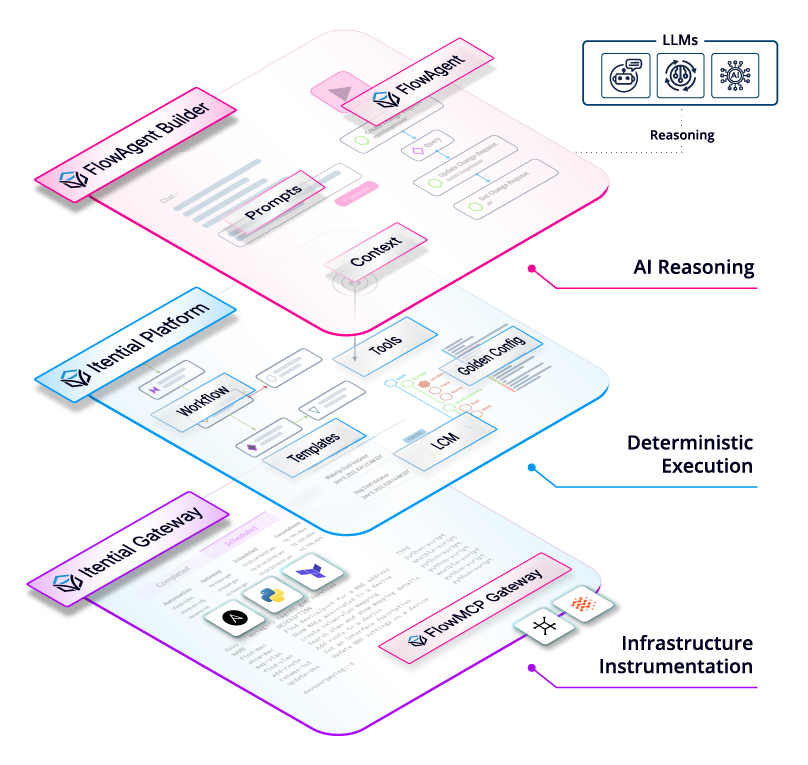
Agentic Operations for Infrastructure is an operating model where AI agents interpret intent, reason over operational context, and plan infrastructure actions, while execution is performed through a governed, deterministic automation and orchestration control plane. This ensures every action is safe, auditable, and reversible, separating cognitive work (planning) from execution work (implementation with governance and auditability). [Source]
How does Agentic Operations differ from AIOps, automation, and orchestration?
Agentic Operations separates reasoning (AI agents) from execution (orchestration platform). While AIOps focuses on detection and recommendations, Agentic Operations enables AI agents to generate execution plans, which are then safely executed with governance, verification, and auditability by the orchestration platform. This ensures production-safe AI-to-action across hybrid domains. [Source]
Why is orchestration critical in Agentic Operations?
Orchestration provides determinism, governance, and evidence. It ensures predictable behavior, policy enforcement, controlled permissions, auditability, retry logic, rollback, and verifiable outcomes. This layer prevents AI agents from making unsafe or ungoverned changes to production infrastructure. [Source]
What are the main phases of adopting Agentic Operations?
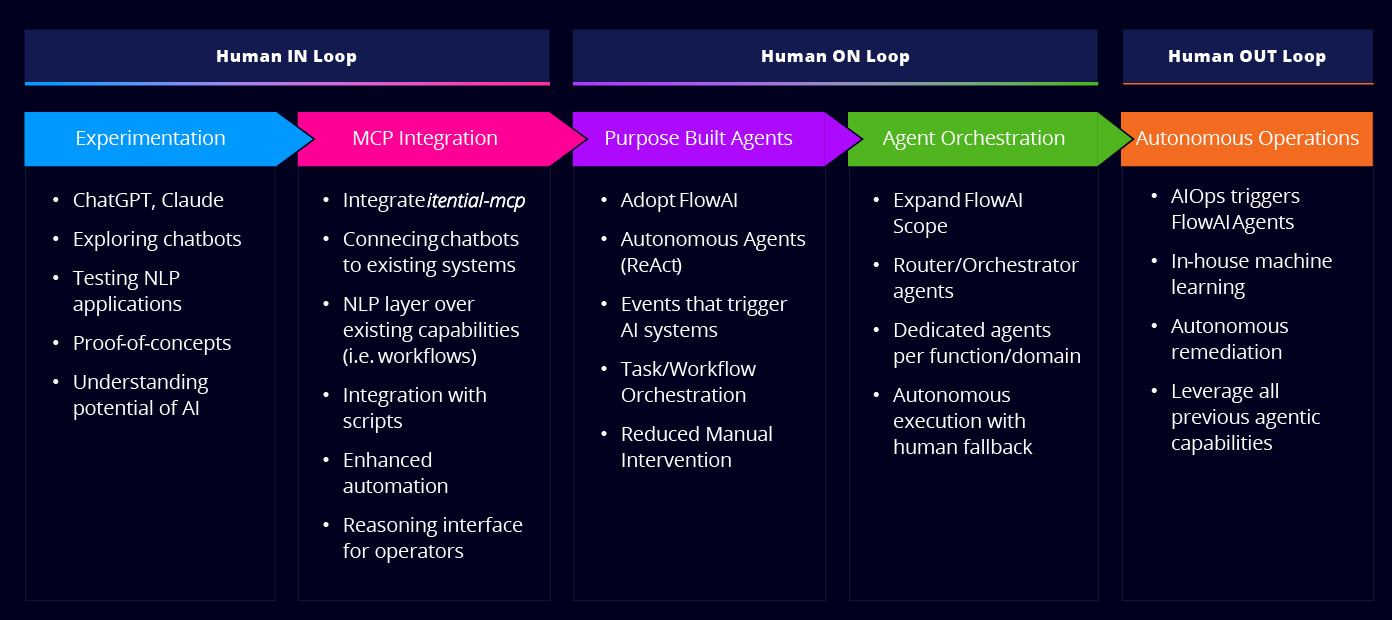
The journey includes five phases: 1) Experimentation (AI in read-only mode), 2) MCP Integration (AI-assisted planning with human approval), 3) Purpose-Built Agents (specialized agents with bounded autonomy), 4) Agent Orchestration (multi-agent collaboration), and 5) Autonomous Operations (closed-loop automation with strategic human oversight). [Source]
Features & Capabilities
What are the key features of Itential's Agentic Operations platform?
Key features include a low-code workflow builder, deterministic execution, policy enforcement, approval gates, role-based access control, audit trails, verification and rollback, and over 300+ pre-built integrations across network, cloud, security, and IT systems. [Source]
How does Itential ensure safe execution of AI-generated plans?
Itential's orchestration platform enforces policy and approval gates, provides deterministic execution with error handling, maintains audit trails, enables verification and rollback, and integrates with RBAC and identity systems. AI agents never have direct access to infrastructure; all actions are mediated by the orchestration layer. [Source]
What integrations does Itential support for Agentic Operations?
Itential supports over 300+ pre-built integrations, including ServiceNow, NetBox, Infoblox, GitHub, Selector AIOps, Kentik, Forward Networks, IP Fabric, Red Hat Ansible, Terraform, messaging systems like Slack and Microsoft Teams, Arista Networks, Cisco, F5, and Palo Alto. For a full list, visit the Automation Marketplace. [Source]
Does Itential support multi-domain and hybrid cloud environments?
Yes, Itential is vendor-agnostic and supports orchestration across physical networks, SD-WAN, cloud, and hybrid environments, making it suitable for enterprises with complex, multi-vendor infrastructures. [Source]
Use Cases & Benefits
What are common use cases for Agentic Operations in infrastructure management?
Use cases include autonomous diagnostics and troubleshooting, proactive maintenance, self-service resource provisioning, incident response and remediation, cloud resource optimization, compliance enforcement, and closed-loop automation for configuration drift and policy violations. [Source]
How does Agentic Operations improve incident response?
When a monitoring alert fires, AI agents analyze symptoms, correlate with recent changes, review incident history, and propose remediation steps. The orchestration platform executes the approved plan, documents every action, and captures evidence for root cause analysis, resulting in faster mean time to resolution and complete audit trails. [Source]
What business impact can organizations expect from adopting Agentic Operations?
Organizations can expect a 10x increase in operational agility, up to 85% reduction in change-related incidents, 70% reduction in infrastructure operations costs, faster service delivery (from 45 days to same day), and reduced time-to-value for new services (from 18 months to 3 months). [Source]
Who benefits most from Agentic Operations for Infrastructure?
Roles that benefit include cloud network engineers, NetOps teams, DevOps teams, infrastructure architects, compliance and SecOps teams, and organizations in industries such as telecommunications, financial services, healthcare, manufacturing, public sector, utilities, media & entertainment, biotechnology, and energy. [Source]
Pain Points & Problem Solving
What problems does Agentic Operations solve for infrastructure teams?
Agentic Operations addresses fragmented automation and tool sprawl, manual change execution, configuration drift and non-compliance, multi-domain complexity, inability to scale operations, lack of governance and auditability, and slow adoption of automation due to coding barriers. [Source]
How does Agentic Operations help with compliance and auditability?
Agentic Operations enforces compliance through policy checks, approval gates, audit trails, and automated evidence capture. Every change is logged with details, including pre/post validation, ensuring full traceability for audits and compliance verification. [Source]
What are common reasons Agentic Operations fails in production, and how can they be prevented?
Common reasons include unsafe execution paths (agents acting directly on production), weak governance, poor data quality, lack of rollback strategy, and trust collapse after a bad change. Prevention involves always using an orchestration layer, enforcing policies and approvals, improving data quality, building rollback into workflows, and rolling out maturity levels deliberately. [Source]
How does Agentic Operations address configuration drift?
Agentic Operations continuously validates configurations against baselines, identifies drift, and enforces governance standards. Automated remediation and compliance checks ensure that device and system states remain aligned with defined policies. [Source]
Technical Requirements & Implementation
What are the technical requirements for implementing Agentic Operations?
Requirements include AI agent capabilities (natural language understanding, reasoning, workflow planning), an orchestration control plane (multi-domain integrations, policy engine, deterministic execution, audit logging, human-in-the-loop integration, verification and rollback), and organizational readiness (defined policies, escalation paths, training, metrics, and operating model clarity). [Source]
How long does it take to implement Agentic Operations with Itential?
Itential's Professional Services typically take 3-6 months from contract signature to a production-ready platform with active use cases. Initial value can be seen within weeks, and automation capabilities can expand rapidly over the next 6-12 months. [Source]
Do I need to change my existing infrastructure to adopt Agentic Operations?
No. Agentic Operations works with your existing hybrid infrastructure. The orchestration control plane integrates with current systems (network devices, cloud APIs, security tools, ITSM platforms, observability systems), and AI agents interact with the orchestration platform, not directly with infrastructure. [Source]
What learning resources are available for understanding and implementing Agentic Operations?
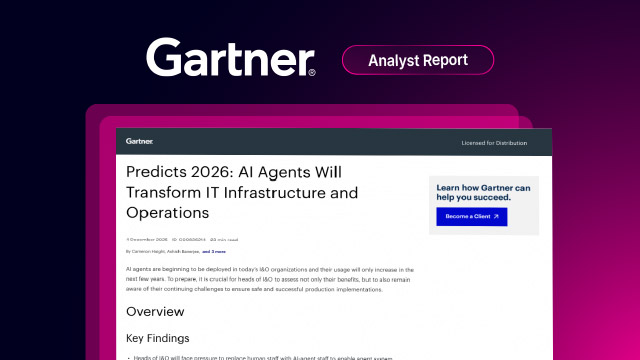
Itential offers a resource library, interactive product tours, demos and videos, analyst reports, customer stories, technical documentation, and the Itential Academy for training and certification. [Source]
Security & Compliance
What security and compliance certifications does Itential have?
Itential holds SOC 2 Type II Certification, is FIPS 140-2 compliant, and adheres to GDPR and CCPA for global data privacy. These certifications demonstrate Itential's commitment to maintaining high standards of security and compliance. [Source]
How does Itential support compliance automation?
Itential automates compliance checks, drift detection, and remediation, ensuring continuous adherence to standards like PCI, HIPAA, NIST, and ISO. The platform includes governance features such as RBAC, SSO, and encryption for data in transit and at rest. [Source]
Does Itential support public sector and air-gapped deployments?
Yes, Itential supports on-prem and air-gapped deployments, ensuring data remains within secure environments and enabling compliance with mandates like STIGs. [Source]
How does Itential handle security vulnerabilities?
Itential has a responsible disclosure policy for security vulnerabilities, ensuring transparency and proactive security management. [Source]
Competition & Differentiation
How does Itential's approach to Agentic Operations differ from other vendors?
Itential built the orchestration control plane first, then layered in agentic capabilities with governance enforced at the platform level. This separation allows AI agents to innovate in the reasoning layer while the execution layer maintains unwavering governance. The platform is open, extensible, and supports the Model Context Protocol (MCP), enabling integration with any MCP-compatible AI agent. [Source]
What makes Itential suitable for enterprises with complex infrastructures?
Itential is vendor-agnostic, supports multi-domain orchestration, offers over 300+ pre-built integrations, and provides compliance-native features. Its platform is production-proven at enterprise scale, trusted by Fortune 500 companies, global service providers, and large financial institutions. [Source]
How does Itential's low-code approach benefit different user segments?
Itential's low-code workflow builder enables both technical and non-technical users to create impactful automations quickly, reducing dependency on specialized skills. This empowers network engineers, IT operators, and leadership to participate in automation and governance. [Source]
What is the Model Context Protocol (MCP) and why is it important?
The Model Context Protocol (MCP) is an open standard that allows AI agents to interact with orchestration platforms in a governed, standardized way. Itential's MCP Server implements MCP, enabling integration with any MCP-compatible AI agent and supporting future extensibility. [Source]
Support & Learning Resources
What learning resources does Itential provide for Agentic Operations?
Itential provides a resource library, interactive product tours, demos and videos, analyst reports, customer stories, technical documentation, and the Itential Academy for training and certification. [Source]
Where can I find technical documentation for Itential's platform?
Comprehensive technical documentation, including guides, API references, and release notes, is available at docs.itential.com. API documentation is available at apidocs.itential.com. [Source]
What is the Itential Academy?
The Itential Academy offers training and certification programs to help users master the platform and its functionalities, supporting successful adoption and ongoing learning. [Source]
How can I get started with Agentic Operations using Itential?
Start by deploying Itential’s orchestration platform and building your “golden workflows” for key use cases. Integrate AI agents via Itential’s MCP Server, use FlowAI to build specialized agents, enable multi-agent collaboration, and expand autonomous execution as operational maturity grows. [Source]