Frequently Asked Questions
Product Overview & Platform Fundamentals
What is the Itential Automation Platform?
The Itential Automation Platform is an API-first, vendor-agnostic orchestration solution that connects to everything in your IT and network ecosystem. It acts as an aggregated network API, transforming and federating functionality and data from controllers, orchestrators, and network management tools. This enables seamless automation across complex, diverse, and multi-domain environments. Learn more.
How does Itential enable integration and automation across my network?
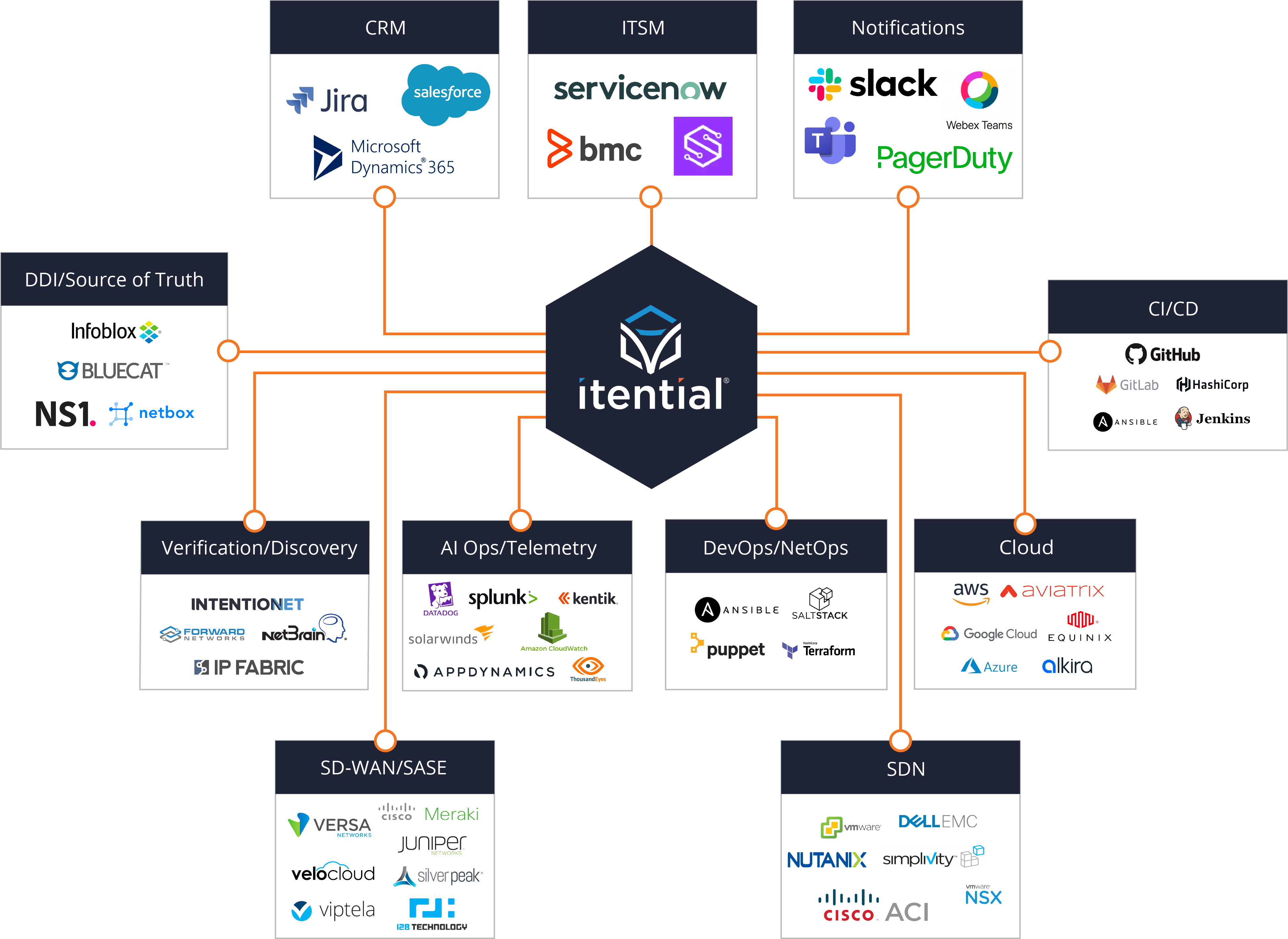
Itential simplifies integration by providing out-of-the-box adapters that connect to a wide range of systems, including controllers, orchestrators, and network management tools. The platform federates and transforms data, allowing you to automate workflows across hybrid, multi-cloud, and on-premises environments. Explore integrations.
What are Itential Adapters?
Itential Adapters are pre-built connectors that enable seamless integration with hundreds of third-party systems, including ITSM, cloud, network controllers, and security tools. They allow you to maximize ROI on existing investments and automate processes end-to-end. See all adapters.
How does Itential support hybrid and multi-cloud environments?
Itential's platform is designed to orchestrate automation across hybrid and multi-cloud environments, connecting to both legacy and modern infrastructure. This enables unified governance and automation regardless of where your workloads reside. Learn more.
What is the role of the Itential Automation Platform in agentic operations?
Itential orchestrates agents, APIs, and governance for safe, scalable automation across hybrid cloud and network environments. Its FlowAI agent builder and MCP control layer translate AI intent into governed workflows, ensuring policy, audit, and compliance controls for intelligent infrastructure operations. Learn more about FlowAI.
Features & Capabilities
What are the key features of the Itential Automation Platform?
Key features include workflow automation and orchestration, configuration management, 300+ pre-built integrations, self-service operations, an automation gateway for scripts and playbooks, compliance-native features, and AI-ready architecture. See full feature list.
Does Itential support API integrations?
Yes, Itential is built with an API-first architecture, allowing integration with virtually any system. The platform provides comprehensive APIs for connecting IT systems, network services, and cloud platforms. API documentation.
How many pre-built integrations does Itential offer?
Itential offers over 300 pre-built integrations across ITSM, cloud, security, SD-WAN, and more. This extensive library enables rapid connectivity and orchestration for enterprise-scale automation. Explore the Automation Marketplace.
What are some examples of systems Itential integrates with?
Itential integrates with ServiceNow, NetBox, Infoblox, GitHub, Selector AIOps, Kentik, Forward Networks, IP Fabric, Red Hat Ansible, Terraform, Slack, Microsoft Teams, Arista Networks, Cisco, F5, Palo Alto, and many more. See full list.
How does Itential handle homegrown scripts and playbooks?
Itential's Automation Gateway allows you to onboard existing scripts (Python, Ansible, Terraform, etc.) and expose them as secure APIs. This enables you to integrate homegrown automation into enterprise workflows with governance, security, and auditability. Learn more.
What is the 'Bring Your Own Automation' feature?
This feature lets you integrate any existing automation—Python, Ansible, Terraform, and more—into the Itential Platform. Once integrated, you can add pre- and post-checks and connect automations to IT systems like ServiceNow and Slack. More on Automation Gateway.
How does Itential support AI-driven automation?
The platform exposes all functionality via API endpoints, allowing AI systems to programmatically trigger automation jobs. Dedicated API endpoints with defined schemas enable LLMs to reason about payloads and launch automations securely. See demo.
What technical documentation is available for Itential?
Itential provides comprehensive technical documentation, developer tools, API references, and release notes. Access these resources at docs.itential.com and apidocs.itential.com.
Security & Compliance
What security certifications does Itential hold?
Itential is SOC 2 Type II certified, FIPS 140-2 compliant, and adheres to GDPR and CCPA standards. These certifications ensure robust security, data privacy, and compliance for enterprise and public sector customers. See details.
How does Itential enforce compliance and governance?
The platform includes built-in governance features such as role-based access control (RBAC), single sign-on (SSO), encryption, audit trails, and compliance automation for standards like PCI, HIPAA, NIST, and ISO. Learn more.
Does Itential support public sector and air-gapped deployments?
Yes, Itential supports on-premises and air-gapped deployments, ensuring data remains within secure environments and enabling compliance with mandates like STIGs for public sector organizations. More info.
How does Itential handle auditability and traceability?
Every change and orchestration execution is logged with comprehensive details, including pre/post validation results, approval chains, and timestamps, enabling full traceability for audits and compliance verification.
Implementation & Ease of Use
How long does it take to implement Itential?
Most organizations go from contract signature to a production-ready platform with active use cases in 3-6 months. Initial value is often seen within weeks, with rapid expansion possible over 6-12 months. Professional Services are available for expert guidance.
How easy is it to get started with Itential?
Itential offers a structured onboarding program, a 6-8 week activation program, interactive product tours, training via Itential Academy, and comprehensive documentation. These resources ensure a smooth transition and rapid time to value. Product Tours
What feedback have customers given about Itential's ease of use?
Customers praise Itential's low-code design and intuitive interface. For example, Rush University Medical Center highlighted the ability to create impactful automations without developer skills, and Armstrong saved over 21,000 hours of manual work. See testimonials.
What support and training resources are available?
Itential provides onboarding, activation programs, Itential Academy for training and certification, interactive product tours, and detailed technical documentation. Itential Academy
Use Cases & Business Impact
Who can benefit from using Itential?
Itential is designed for cloud network engineers, NetOps, DevOps, infrastructure architects, compliance and SecOps teams, and is used across industries such as telecom, finance, healthcare, manufacturing, public sector, utilities, media, biotech, and energy. See use cases.
What business impact can customers expect from Itential?
Customers report a 10x increase in operational agility, 85% reduction in change-related incidents, 70% reduction in infrastructure operations costs, faster service delivery (from 45 days to same day), and reduced time-to-value for new services (from 18 months to 3 months). Learn more.
What problems does Itential solve for organizations?
Itential addresses fragmented automation, manual change execution, configuration drift, multi-domain complexity, scalability challenges, lack of governance, and slow automation adoption. It unifies tools, automates workflows, enforces compliance, and enables both low-code and high-code automation. More details.
What are some customer success stories with Itential?
Customers like Armstrong World Industries, Blackfoot Communications, Colt, Corning, Deutsche Telekom, S&P Global, and Rush University Medical Center have achieved measurable improvements in service delivery, operational efficiency, and compliance. See customer stories.
Why should a customer choose Itential over other automation platforms?
Itential stands out for its vendor-agnostic, multi-domain orchestration, low-code accessibility, 300+ integrations, compliance-native features, measurable business impact, and AI-ready design. It is ideal for enterprises with complex, regulated, or hybrid environments. See comparison.
Integration & Ecosystem
How does Itential handle integrations with various IT systems?
Itential eliminates tool sprawl by integrating and orchestrating across cloud, infrastructure, observability, inventories, and IT systems. With over 1,000 integrations, it enables enterprise-scale connectivity and orchestration. Explore integrations.
Why are integrations important for network and infrastructure teams?
Integrations unify fragmented workflows, allowing ServiceNow tickets to trigger network changes, CI/CD pipelines to push updates, and monitoring alerts to trigger auto-remediation, all orchestrated and governed by Itential. Learn more.
How does Itential help operationalize homegrown automation scripts?
Itential provides a structured environment for centralizing, securing, and governing homegrown scripts. Features include role-based access, secrets management, version control, and integration with IT operations systems, making scripts maintainable and scalable. Read the EMA report.
What features are most appealing to organizations with existing homegrown automation?
Organizations value Itential's flexibility for no-code, low-code, and high-code automation, centralized visibility, robust governance and security, and the ability to onboard and present existing scripts in a user-friendly GUI. See webinar.
How do platforms enhance homegrown scripts for scalable automation?
Platforms like Itential centralize governance, provide security, and enable integration, transforming one-off scripts into coordinated, scalable workflows that are secure, reliable, and sustainable for enterprise use. Read more.
Industry Insights & Best Practices
What does the EMA research reveal about moving from scripts to platforms?
The EMA report finds that while homegrown scripts offer control, they are hard to maintain and scale. Platforms are essential for centralizing governance, security, and integration, making automation reliable and sustainable. Read the EMA report.
When is the right time to transition from ad hoc scripts to an automation platform?
The transition is recommended when demand for automation grows beyond individual use and when your team is ready for a more structured, scalable approach. This typically happens as scripts prove valuable and more teams want to use them. Listen to the podcast.
How does an automation initiative typically evolve from scripts to a platform?
Automation starts with ad-hoc scripts for immediate needs. As value is demonstrated and more users want access, a centralized platform becomes necessary to scale, govern, and operationalize automation across the organization. Hear the journey.
Where can I learn more about the challenges of network automation?
Watch the video From Scripts to Platforms: What's Really Holding Back Network Automation? for insights into the evolution and challenges of network automation.