Frequently Asked Questions
Integrations & Ecosystem
What types of integrations does the Itential Platform support?
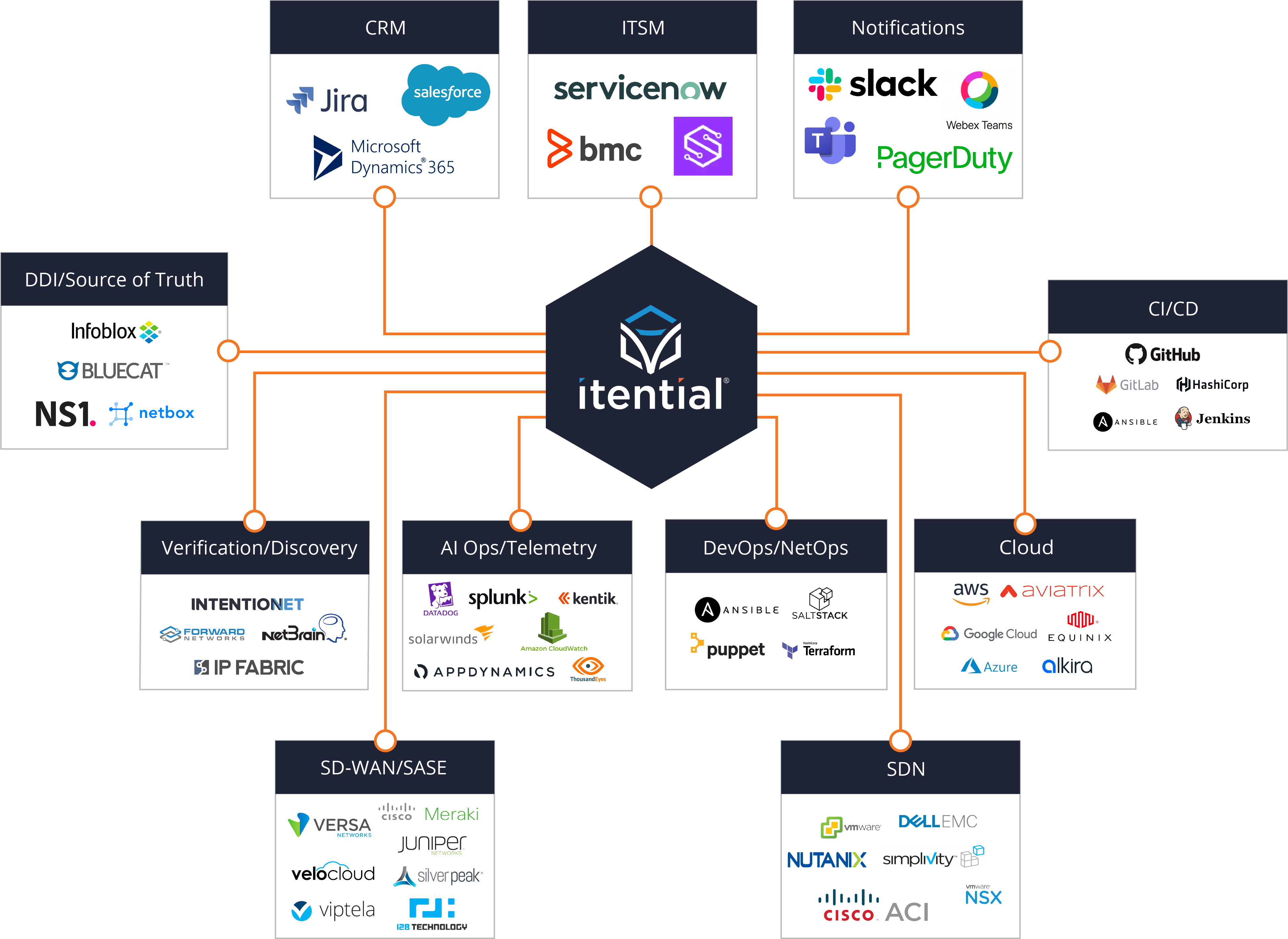
The Itential Platform supports over 300 pre-built integrations with a wide range of IT, network, cloud, and automation tools. These include ServiceNow (ITSM), NetBox (Source of Truth), Infoblox (DDI), GitHub (Source Control), Selector AI (AIOps), Kentik (Network Observability), Forward Networks (Network Verification), IP Fabric (Network Assurance), and platforms like Alkira, Arista, Aviatrix, Cisco, F5, Juniper, Palo Alto, and Terraform. For a complete list, visit the Automation Marketplace.
Can I build custom integrations with the Itential Platform?
Yes, Itential enables users to build custom integrations using its no-code adapter builder. This allows you to connect homegrown or proprietary systems in minutes, even if they are not covered by existing adapters. Start building at the Adapter Builder.
Does Itential integrate with custom-built scripts and automation tools?
Yes, the Itential Platform can integrate with and utilize Python scripts, Ansible Playbooks, and Terraform/OpenTofu plans within end-to-end workflow orchestrations. This allows you to leverage your existing automation investments without starting from scratch.
How does Itential provide a unified view of my network and IT assets?
Itential’s patented data federation approach centralizes business logic and provides a real-time, federated view of all devices, resources, and systems across distributed network infrastructure. This enables unified device management, real-time visibility, and dynamic response to network changes.
Can I transform data between different systems using Itential?
Yes, Itential’s patented data modeling and translation capabilities unify connections between networks and systems with different data models by converting them into a common, human-readable JSON format. You can use reusable JSON Schema Transformations (JSTs) and access a library of pre-built data transformations.
How does Itential’s northbound exposure model work?
Itential’s northbound exposure model provides a single, aggregated API for self-service network access, enabling other IT teams to easily consume network services. It supports integration with CI/CD pipelines, zero-touch automation, and publishing workflows into ServiceNow for rapid service delivery.
Can AI copilots leverage Itential integrations?
Yes, AI copilots can orchestrate across any integrated systems such as ServiceNow, Ansible, Terraform, and more. However, execution is always validated through Itential workflows to ensure governance and compliance.
How quickly can I automate new use cases with Itential integrations?
With Itential’s extensive pre-built integration library and no-code tools, the time to automate and deploy new use cases can be accelerated from months to less than one day, with no custom integration development required.
How does Itential help eliminate technology debt from custom integrations?
Itential eliminates technology debt by providing a comprehensive library of pre-built integrations and reusable data transformations, reducing the need for custom development and ongoing maintenance of point-to-point solutions.
Can I integrate Itential with my CI/CD pipelines?
Yes, Itential’s unified network API and workflow orchestration can be integrated into CI/CD pipelines, allowing developers and pipeline owners to deliver self-service network capabilities to IT teams and automate infrastructure changes as part of their DevOps processes.
Features & Capabilities
What are the key features of the Itential Platform for integrations?
Key features include an extensive pre-built integration library, no-code adapter builder, support for integrating scripts and custom automations, real-time federated device management, dynamic response to network changes, reusable data transformations, and a unified network API for self-service and automation.
How does Itential simplify integration with diverse network and IT systems?
Itential’s API-first approach and patented data modeling translate all data into a common JSON language, removing the need to learn multiple technologies and simplifying automation across physical, virtual, and cloud networks.
What is the benefit of Itential’s real-time federated view?
The real-time federated view enables centralized management and visibility of all devices and resources across distributed networks, allowing for immediate detection and response to changes such as new deployments or device decommissioning.
How does Itential maximize ROI for integration projects?
Itential maximizes ROI by allowing organizations to leverage and integrate existing tools and systems, reducing the need for new investments and providing flexibility to integrate with future technologies as needs evolve.
What is the advantage of using Itential’s no-code integration tools?
The no-code adapter builder allows users to quickly create integrations without programming expertise, reducing development time and enabling faster automation of new use cases.
How does Itential support vendor flexibility?
Itential’s vendor-agnostic approach allows organizations to switch vendors easily and avoid lock-in to proprietary environments, supporting orchestration across physical, SD-WAN, cloud, and hybrid networks.
Can I publish workflows into ServiceNow using Itential?
Yes, you can publish and run infrastructure automations directly from the ServiceNow Platform, reducing the time to complete new requests and rapidly delivering services to end users.
How does Itential mitigate the need for custom development?
By providing a vast library of pre-built integrations and reusable data transformations, Itential reduces the need for custom development, enabling teams to automate and orchestrate use cases that previously required specialized tools or coding.
What is the role of reusable JSON Schema Transformations (JSTs) in Itential?
Reusable JSTs allow engineers to build data transformations once and repurpose them across multiple workflows, increasing efficiency and consistency in data handling between systems.
How does Itential ensure real-time updates to network views?
Itential automatically detects and updates changes such as new deployments or device decommissioning, ensuring your network view stays current and accurate at all times.
API & Technical Documentation
Does Itential provide an API for integrations?
Yes, Itential provides robust, open RESTful APIs that expose more than 90% of its functionality. These APIs enable seamless integration with other tools, programmatic control of network functions, and support for self-service and automation workflows. Explore the full API documentation at apidocs.itential.com.
Where can I find technical documentation for Itential integrations?
Comprehensive technical documentation, including installation guides, API references, and detailed usage instructions, is available at docs.itential.com. Release notes and developer tools are also provided to support your integration projects.
Does Itential offer open-source projects or SDKs for integration?
Yes, Itential offers open-source projects and SDKs on GitHub and GitLab, enabling developers to accelerate integration and automation efforts.
How much of Itential’s functionality is accessible via API?
More than 90% of Itential’s platform functionality is accessible via open, RESTful APIs, allowing for extensive automation and integration with external systems.
Can I automate data extraction and insertion for NetOps workflows using Itential APIs?
Yes, the Template IDE API allows programmatic access to search for templates and compile functionality, enabling automation of data extraction and insertion for NetOps workflows.
Does Itential support integration into CI/CD pipelines via API?
Yes, Itential’s APIs are central to its Network as a Service (NaaS) solution, enabling integration into CI/CD pipelines, self-service portals, and IT processes for automated network operations.
Where can I find developer tools for building integrations with Itential?
Developer tools and resources to accelerate integration development are available at Itential's developer tools page.
Does Itential provide release notes for integration features?
Yes, you can stay updated on the latest features and updates through Itential's release notes.
Security & Compliance
What security certifications does Itential hold?
Itential has achieved SOC 2 Type 2 compliance, verifying its commitment to security, availability, confidentiality, and processing integrity. The platform also adheres to GDPR and CCPA data privacy regulations. For more details, visit the Security & Compliance page.
How does Itential ensure secure integrations?
Itential includes built-in security features such as role-based access control (RBAC), zero-trust policies, separation of duties, and comprehensive audit logging. Compliance-native design automates compliance checks and provides immutable audit logs for regulatory requirements.
Is Itential suitable for regulated industries?
Yes, Itential is designed to meet the stringent security and compliance requirements of industries such as financial services, healthcare, energy, and the public sector, with features supporting audit readiness and regulatory compliance.
Where can I find more information about Itential’s security posture?
Detailed information about Itential’s security posture, compliance certifications, and data handling practices is available on the Security & Compliance page.
Pricing & Plans
How is Itential’s pricing model structured for integrations?
Itential’s pricing is based on software licenses (for the platform, Automation Gateway, and applications) and device or node element licenses, which scale with the number of devices or resources managed. There are no charges for users, transactions, workflows, or API calls. For cloud deployments, pricing includes a fixed annual subscription and node-element licenses. For on-premises or hybrid deployments, there is a one-time deployment-architecture fee. Learn more at the pricing page.
Use Cases & Benefits
What problems does Itential solve for integration teams?
Itential addresses challenges such as fragmented automation tools, manual change execution, configuration drift, multi-domain complexity, inability to scale operations, lack of governance, and slow adoption of automation. Its unified, low-code, and compliance-focused platform streamlines integration and orchestration across the enterprise.
Who can benefit from Itential’s integration capabilities?
Network engineers, IT managers, DevOps teams, SecOps leaders, platform and AI teams, CIOs, and IT executives across industries such as enterprise networks, financial services, healthcare, manufacturing, energy, public sector, communications, and AI data centers can benefit from Itential’s integration capabilities.
What are some real-world examples of Itential integrations in action?
Examples include Deutsche Telekom achieving a 4,400% increase in router upgrades by unifying automation tools, S&P Global delivering same-day network services through self-service automation, and a major U.S. airline eliminating network downtime across 5,000+ devices with Golden Configurations. See more at customer stories.
How does Itential help unify fragmented automation tools?
Itential’s integration-first approach connects ITSM, CI/CD, observability tools, and network controllers, eliminating silos and enabling end-to-end governance and orchestration across the entire IT ecosystem.
How quickly can I implement Itential integrations?
Most customers complete their first production workflow within 30–45 days, thanks to pre-built adapters, workflow templates, and the Automation Gateway, which ingests existing scripts for rapid deployment.
What are the benefits of Itential’s low-code integration approach?
The low-code, drag-and-drop interface enables both technical and non-technical users to create impactful automations quickly, reducing dependency on specialized skills and accelerating adoption across teams.
How does Itential support self-service operations?
Itential empowers users with self-service catalogs to request and deploy network services on-demand, compressing service delivery times from days to minutes and reducing manual effort by up to 90%.
What feedback have customers given about Itential’s integration ease of use?
Customers like Uzair Khan of RUSH University Medical Center have praised Itential for its user-friendly, low-code design, stating that impactful automations can be created quickly without needing to be a developer. The platform’s drag-and-drop interface makes workflow creation accessible to all users. Read more customer feedback.
What industries are represented in Itential’s integration case studies?
Industries include enterprise networks, financial services, healthcare, manufacturing, energy & utilities, public sector, communications service providers, NeoCloud & AI data centers, and media & entertainment. See the full list at customer stories.
How does Itential compare to other integration platforms?
Itential stands out with its vendor-agnostic orchestration, low-code accessibility, integration-first approach, compliance-native features, and measurable business impact. Unlike competitors tied to specific ecosystems, Itential supports orchestration across diverse environments and offers over 300 pre-built integrations. Learn more about Itential’s differentiators.