...
Itential Platform Pricing Explore flexible plans and options for your team

Itential logo
Analyst Report

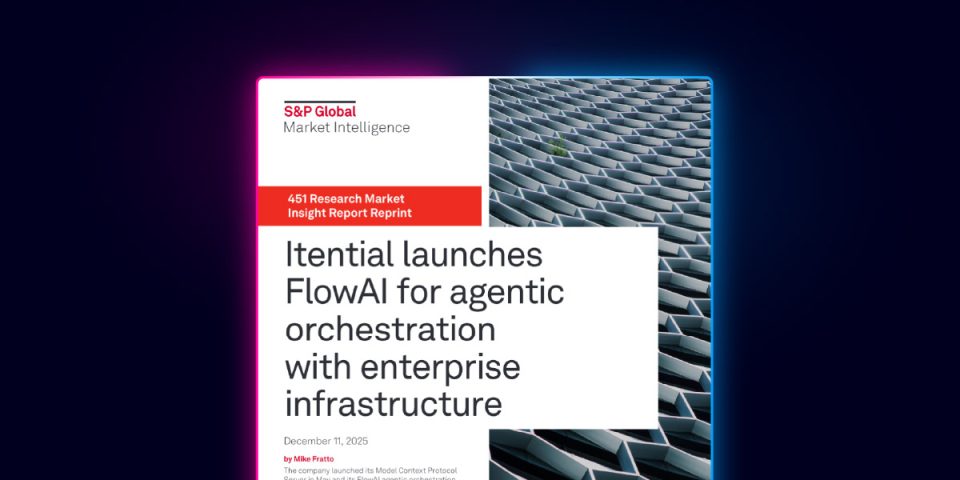
451 Research: FlowAI Goes GA. Itential Goes Agentic-First.

FlowAI is generally available, and it marks a deliberate repositioning: Itential is moving from a network automation vendor to the agentic operations platform for infrastructure. Build-time governance, a consumption-based model, and a developer-first entry point through Claude Code are what make agentic-first operations safe to run in production.

451 Research, part of S&P Global Market Intelligence, covered the launch and validates the shift occurring in the network automation market.

The Inflection Point

The Shift From AI Experimentation to Production

Agentic AI changes the operating model for network and infrastructure teams. Traditional automation executes predefined tasks. Agentic systems reason, adapt to changing conditions, and choose actions based on context instead of static rules.

That capability is the opportunity. It is also the risk. The question enterprises face is not whether an AI agent can reason. It is whether teams can trust one to act in production without bypassing approvals, violating policy, or triggering cascading failures across complex infrastructure.

The barrier to production is control, not capability. Enterprises need guardrails, audit trails, and defined access policies before AI agents touch live infrastructure. FlowAI is built to deliver exactly that.

451 Research examined this governance challenge in depth. Read the full analyst report.

The Market Shift

Itential: From Workflow Automation to Agentic Operations

FlowAI is Itential’s agentic harness for building, deploying, and running AI agents on enterprise infrastructure. It extends the Itential Platform with governed, auditable agent execution, uniting reasoning intelligence with deterministic execution across hybrid infrastructure.

The general availability of FlowAI is more than a feature release. It is a strategic repositioning: Itential moving from a workflow automation vendor to an agentic operations platform. Rather than treating AI as an external decision engine, FlowAI embeds reasoning directly into governed operational processes, so enterprises can progress from AI-assisted recommendations to autonomous execution without giving up control.

451 Research characterized the general availability of FlowAI as a strategic repositioning, from network automation vendor to agentic operations platform.
How It Works

How FlowAI Enables Agentic Operations

FlowAI brings together the components enterprises need to put agents into production with governance intact.

Governance Set at Build Time, Not Retrofitted at Runtime

Itential built FlowAI on a single principle: governance is established at build time, not bolted on at runtime. Builder access, agent permissions, and execution controls are each defined independently, so the constraints an agent operates under are fixed before it ever runs a task. Human-in-the-loop checkpoints are available at any stage before an irreversible action. That is what gives enterprises the auditability and control required to run AI in production.

The Core Components: FlowAgents, FlowAgent Builder, & FlowMCP Gateway

FlowAI extends the Itential Platform with three core agentic components, all generally available. FlowAgents are task-oriented reasoning agents that work toward goals through governed workflows, with full reasoning traces preserved for audit. The FlowAgent Builder is where teams create role-based agents with defined purposes, toolsets, and policy boundaries. FlowMCP Gateway extends Itential governance, authentication, and policy enforcement to external infrastructure agents and MCP tools through the Itential Gateway.

A Developer-First Entry Point Through Claude Code

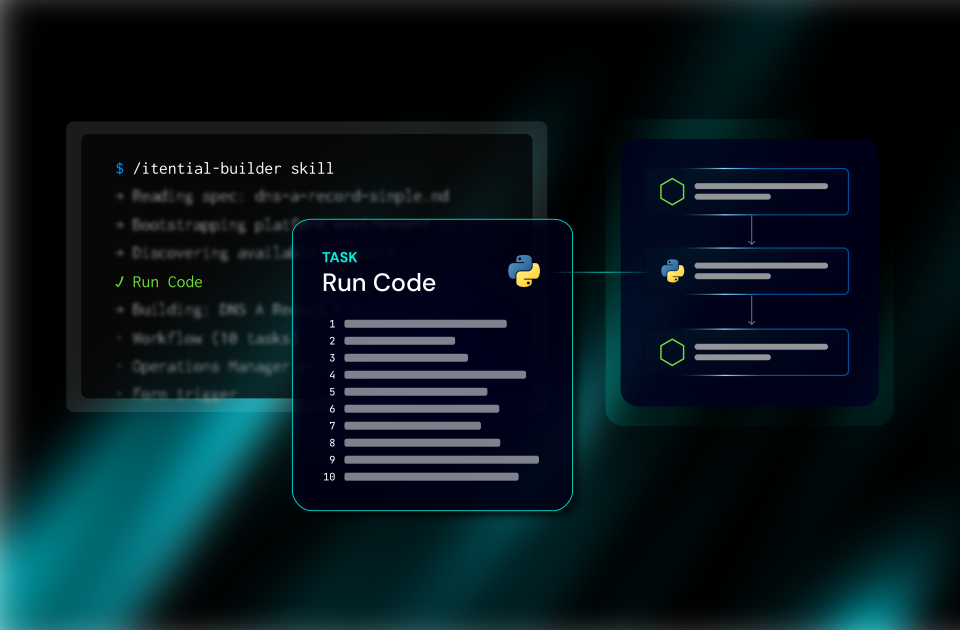
Itential Builder Skills for Claude Code bring Spec-Driven Development (SDD) to infrastructure automation. The package includes one plug-in, 13 skills, and three delivery agents: a Spec Agent, a Solution Architecture Agent, and a Builder Agent. Each owns a distinct stage of the automation life cycle from requirements through deployment, and the skills generate and deploy workflows, command templates, configuration management assets, life cycle manager resources, and FlowAgents directly into an Itential Platform environment. This puts Itential in front of engineering teams that evaluate infrastructure tools independently of traditional IT procurement.

451 Research identified Itential’s build-time governance model as its central technical differentiator, the mechanism that addresses the primary barrier to production AI: trust.
The Operating Model

A Workflow Lifecycle That Bridges Flexibility & Discipline

FlowAI is not a replacement for deterministic automation. It treats agentic and deterministic execution as two settings on the same platform, not competing philosophies.

Teams start with agentic execution for variable, hard-to-predict tasks. As patterns prove out, they harden them into deterministic workflows for cost and speed efficiency. If conditions change and errors emerge, they flex back to agentic. One platform, one governance model, and the right execution mode for the job.

This is what makes the progression toward autonomy intentional and governed. Without a platform to manage it, autonomy tends to emerge organically through disconnected scripts, tools, and integrations, which increases risk instead of reducing it.

Market Timing

Why Enterprises Are Acting Now

The timing of the FlowAI GA is not arbitrary. Several forces are converging at once, and together they turn governed agentic operations from a future consideration into a near-term requirement.

Enterprises are moving AI initiatives out of experimentation and into production, where advisory-only AI no longer justifies the investment. Infrastructure vendors are exposing telemetry and command interfaces through open standards like MCP, giving agents real, structured access to the systems they need to act on. And AI agents themselves have crossed a capability threshold: they can now reason across operational context and take meaningful action, not just summarize it.

At the same time, none of the constraints have relaxed. Regulatory scrutiny, compliance requirements, change-control discipline, and operational risk are as demanding as ever. That is the tension defining this moment. The capability to act autonomously has arrived faster than most organizations’ ability to govern it. Teams that adopt agentic operations without a governance model inherit speed and risk in equal measure. Teams that adopt one built for control get the speed without the exposure.

This is the window FlowAI is built for: agents capable enough to matter, standards mature enough to connect them, and governance strong enough to let enterprises say yes.

The Commercial Model

Pricing That Scales With Value, Not Device Count

For years, infrastructure automation was priced the way infrastructure was bought: per device. That worked when the estate was the thing that grew. It stopped working the moment automation volume, not device count, became the real measure of value. Per-device licensing capped the platform’s worth in exactly the environments where teams were automating most aggressively, penalizing the customers doing the most.

FlowAI’s general availability comes with a different model. Pricing is consumption-based, tied to execution rather than static inventory. Cost tracks actual platform use and successful outcomes, so teams pay for the work the platform does, not for the number of things they happen to own. For engineering-led buyers, that changes the entry point entirely. They can start with a single use case, prove value, and scale usage on tangible operational results instead of negotiating against a device count.

It is also a deliberate signal. The model leads with agentic building, aligning the commercial structure with the operating shift the platform represents. The economics and the architecture point the same direction: toward agentic-first operations, adopted at the pace and scale the team is ready for.

451 Research flagged Itential’s shift from per-device licensing to a consumption-based, per-action model as a notable commercial signal, one that aligns cost with platform use and lowers the barrier for engineering-led buyers evaluating code-first alternatives.
The Foundation

Built on a Proven Enterprise Platform

FlowAI extends a platform already trusted to orchestrate complex infrastructure workflows across hybrid and multi-vendor environments. Itential serves more than 100 customers, including six of the 10 largest service providers and three of the five largest financial services companies, with deep integration, configuration management, workflow orchestration, and enterprise-grade security and compliance built in.

The general availability of FlowAI follows six months of validation through the FlowAI Innovation Program, in which six enterprises tested it against production infrastructure across telecom, financial services, and utilities. FlowAI builds on that foundation so teams can adopt agentic operations without abandoning existing processes or tooling.

When you’re operating infrastructure at Lumen’s scale, the question was never whether AI could help – it was whether we could trust it in production and Itential’s FlowAI answered that. Our teams were building production-ready agents in minutes, within the same governance and access controls we already rely on. As we build the next digital backbone for AI, this is the next evolution in our journey with Itential and it’s redefining how we operate networks at scale.
Image of Greg Freeman
Greg Freeman
Vice President, Network and Customer Transformation, Lumen
Analyst Validation

Independent Analyst Validation

The FlowAI GA drew independent coverage from 451 Research, part of S&P Global Market Intelligence, which positioned Itential as a bridge between AI innovation and production readiness, enabling enterprises to deploy agentic AI without compromising security, compliance, or operational integrity.

The conclusion is direct: the future of AI in infrastructure will not be defined by insight alone. It will be defined by governed, operational execution. With FlowAI generally available, that future is shipping.

Get Started

See Agentic-First Operations in Action

FlowAI is generally available now. Explore what governed, agentic-first operations look like on the Itential Platform, or see it running against your own use cases in a live demo.
Talk to Our Experts
Keep Learning

The Latest in Agentic Operations & Infrastructure

Get Started

Agentic infrastructure operations starts here.

See how Itential connects AI reasoning to governed execution across your entire infrastructure.