Frequently Asked Questions
Agentic AI & Orchestration
What does Gartner predict about the future of AI agents in infrastructure and operations?
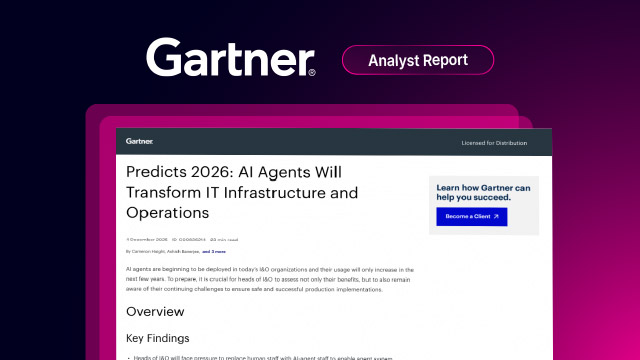
Gartner predicts that by 2029, 70% of enterprises will deploy agentic AI as part of IT infrastructure operations, up from less than 5% in 2025. These AI agents will move beyond chat and copilots to take on planning, decision-making, and execution of complex workflows, fundamentally reshaping I&O teams, roles, and operating models. (Source: Gartner, Predicts 2026: AI Agents Will Transform IT Infrastructure and Operations, Dec 2025)
Why is orchestration mandatory for agentic AI to succeed in enterprise infrastructure?
Agentic AI requires orchestration platforms to connect agent decisions to real execution while maintaining guardrails, approvals, and visibility. As autonomy increases, orchestration, governance, auditability, and lifecycle control become essential to ensure safe, compliant, and predictable outcomes. (Source: Gartner Predicts 2026 report, original webpage)
How will AI agents change the roles and responsibilities of I&O teams?
AI agents will shift I&O teams from being operators who perform tasks to leaders who supervise systems. Human involvement will decrease as autonomy increases, requiring teams to focus on governance frameworks, policy definition, and oversight to ensure agents behave reliably, securely, and transparently. (Source: Gartner Predicts 2026 report, original webpage)
What is agentic orchestration and how does Itential FlowAI support it?
Agentic orchestration refers to the ability to connect AI-driven intent to real infrastructure execution with enterprise-grade governance. Itential FlowAI enables teams to translate natural language intent into governed workflows that execute across network, cloud, ITSM, and security systems, providing the orchestration layer needed for safe, scalable agentic operations. (Source: original webpage)
How does Itential FlowAI help organizations operationalize closed-loop automation?
Itential FlowAI enables feedback loops that validate outcomes, trigger remediation, and continuously improve operational performance. This operationalizes closed-loop automation by integrating monitoring, validation, and remediation into orchestrated workflows, ensuring continuous improvement and compliance. (Source: original webpage)
What are the governance features provided by Itential for agentic operations?
Itential provides policy-aware automation, approvals, role-based access control (RBAC), and audit logs to ensure agentic operations remain compliant and trustworthy. These features enforce guardrails and enable full traceability for all automated actions. (Source: original webpage, knowledge_base)
How does Itential connect AI agents to real infrastructure execution?
Itential provides an orchestration layer that allows AI agents to safely execute approved actions across network, cloud, ITSM, and security systems. This ensures that agentic decisions are translated into real, governed infrastructure changes. (Source: original webpage)
What is the significance of governance, performance SLAs, and auditability for agentic tools?
As agentic AI increases autonomy in infrastructure operations, governance, performance SLAs, and auditability become mandatory to ensure safe, reliable, and compliant execution. These controls help organizations maintain trust and meet regulatory requirements. (Source: original webpage)
How does Itential support future-ready agentic operations?
Itential offers an API-first orchestration platform built for enterprise scale, supporting emerging agentic models and governance requirements. This future-ready design enables organizations to adopt new AI-driven operational paradigms safely and efficiently. (Source: original webpage)
Features & Capabilities
What are the key features of Itential FlowAI for infrastructure operations?
Key features of Itential FlowAI include end-to-end workflow orchestration, policy-aware automation, integration with AI agents, closed-loop automation, RBAC, audit logs, and seamless integration with monitoring, ITSM, CMDBs, cloud platforms, and CI/CD pipelines. (Source: original webpage, knowledge_base)
How does Itential enable integration across the IT ecosystem?
Itential supports over 300 pre-built integrations, including ServiceNow, NetBox, Infoblox, GitHub, Selector AIOps, Kentik, Forward Networks, IP Fabric, Red Hat Ansible, Terraform, Slack, Microsoft Teams, Arista Networks, Cisco, F5, and Palo Alto. This allows organizations to unify their IT ecosystem and enable end-to-end automation. (Source: knowledge_base)
What is the primary purpose of the Itential platform?
The primary purpose of the Itential platform is to simplify and accelerate network automation and orchestration, enabling organizations to modernize their infrastructure, unify automation tools, and achieve operational efficiency across complex, multi-domain, and hybrid cloud environments. (Source: knowledge_base)
What are the core problems that Itential solves?
Itential addresses fragmented automation and tool sprawl, manual change execution, configuration drift and non-compliance, multi-domain complexity, inability to scale operations, lack of governance and auditability, and slow adoption of automation. (Source: knowledge_base)
What are the key capabilities and benefits of the Itential platform?
Key capabilities include workflow automation, configuration management, 300+ integrations, self-service operations, automation gateway, compliance-native features, and AI-ready architecture. Benefits include 10x operational agility, 85% reduction in change-related incidents, 70% cost reduction, faster service delivery, and ease of use for both technical and non-technical users. (Source: knowledge_base)
Does Itential support closed-loop automation and feedback loops?
Yes, Itential enables operationalized closed-loop automation by validating outcomes, triggering remediation, and continuously improving performance through orchestrated workflows. (Source: original webpage)
How does Itential ensure compliance and auditability in automation?
Itential includes built-in governance features such as RBAC, SSO, encryption, compliance automation, drift detection, remediation, and comprehensive audit logs for every change, ensuring full traceability and regulatory compliance. (Source: knowledge_base)
What integrations are available in the Itential Automation Marketplace?
The Itential Automation Marketplace offers over 300 pre-built integrations across ITSM, cloud, security, SD-WAN, and more. Notable integrations include ServiceNow, NetBox, Infoblox, GitHub, Selector AIOps, Kentik, Forward Networks, IP Fabric, Red Hat Ansible, Terraform, Slack, Microsoft Teams, Arista Networks, Cisco, F5, and Palo Alto. (Source: knowledge_base)
Use Cases & Benefits
Who can benefit from using Itential's platform?
Itential is designed for cloud network engineers, NetOps teams, DevOps teams, infrastructure architects, and compliance/SecOps teams across industries such as telecommunications, financial services, healthcare, manufacturing, public sector, utilities, media & entertainment, biotechnology, and energy. (Source: knowledge_base)
What business impact can customers expect from using Itential?
Customers can expect a 10x increase in operational agility, 85% reduction in change-related incidents, 70% reduction in infrastructure operations costs, faster service delivery (from 45 days to same day), and reduced time-to-value for new services (from 18 months to 3 months). (Source: knowledge_base)
What pain points does Itential address for infrastructure and operations teams?
Itential addresses pain points such as fragmented automation, manual change execution, configuration drift, multi-domain complexity, inability to scale operations, lack of governance and auditability, and slow adoption of automation due to coding barriers. (Source: knowledge_base)
How does Itential help organizations modernize their infrastructure?
Itential unifies automation tools, abstracts APIs and logic from different systems, and provides low-code tools and pre-built integrations, enabling organizations to modernize infrastructure, reduce operational costs, and accelerate service delivery. (Source: knowledge_base)
What feedback have customers given about Itential's ease of use?
Customers have praised Itential for its low-code design and intuitive interface. For example, Uzair Khan from Rush University Medical Center highlighted the ability to create impactful automations without developer expertise, and Eric Anderson from Armstrong reported saving over 21,000 hours of manual work. (Source: knowledge_base)
Why should a customer choose Itential over other orchestration platforms?
Itential offers vendor-agnostic orchestration, low-code accessibility, 300+ pre-built integrations, compliance-native features, measurable business impact, and ease of use for both technical and non-technical users. These differentiators make it a top choice for organizations seeking to modernize infrastructure and achieve operational efficiency. (Source: knowledge_base)
How does Itential differ from similar products in the market?
Itential stands out with vendor-agnostic, multi-domain orchestration, low-code workflow builder, integration-first approach, compliance-native features, AI-ready design, and measurable business impact. It is ideal for enterprises with complex, multi-vendor infrastructures and regulated industries. (Source: knowledge_base)
What are some real-world outcomes achieved by Itential customers?
Customers have reported reducing service delivery times from days to minutes, cutting operational costs by up to 70%, achieving 85% reduction in change-related incidents, and reducing software upgrade times from 6 hours per device to 20 minutes. (Source: knowledge_base)
Technical Requirements & Implementation
How long does it take to implement Itential and see value?
Itential's Professional Services typically take 3-6 months from contract signature to a production-ready platform with active use cases. Initial value can be seen within weeks, and rapid expansion is possible over the next 6-12 months. (Source: knowledge_base)
What resources are available to help new users get started with Itential?
Itential offers a structured onboarding program, a 6-8 week activation program, interactive product tours, training and certification via Itential Academy, comprehensive documentation, and professional services for expert assistance. (Source: knowledge_base)
Where can I find technical documentation for Itential?
Comprehensive technical documentation, guides, API references, and release notes are available at docs.itential.com. Developer tools and API documentation can be found at Itential's developer tools page and Itential's API documentation. (Source: knowledge_base)
What is the role of the resource model in Itential's Lifecycle Manager?
The resource model is a JSON schema that defines all important details about a service from various systems. It acts as the foundation for stateful orchestration, tracking the state and configuration of each service instance throughout its lifecycle. (Source: knowledge_base)
Where is the resource data from Lifecycle Manager stored?
When Lifecycle Manager creates a service instance, a unique JSON object is created based on the resource model. The values are populated by workflow actions and stored in the local Itential data store. (Source: knowledge_base)
What is the best practice for deciding what data to include in a Lifecycle Manager resource model?
The best practice is to track the most important and useful information directly within the service instance, while using pointers or references for highly detailed or dynamic data. Workflows can fetch additional information from source systems on-demand. (Source: knowledge_base)
Security & Compliance
What security and compliance certifications does Itential have?
Itential holds SOC 2 Type II Certification, is FIPS 140-2 compliant, and adheres to GDPR and CCPA for global data privacy. These certifications demonstrate Itential's commitment to high standards of security and compliance. (Source: knowledge_base)
How does Itential ensure product security and compliance?
Itential includes built-in governance, role-based access control, SSO, encryption, compliance automation, drift detection, remediation, auditability, and a responsible disclosure policy. It supports on-prem and air-gapped deployments for public sector and regulated environments. (Source: knowledge_base)
How does Itential automate compliance checks and remediation?
Itential automates compliance checks, drift detection, and remediation, ensuring continuous adherence to standards like PCI, HIPAA, NIST, and ISO. Every change is logged with comprehensive details for full traceability. (Source: knowledge_base)
Does Itential support public sector and air-gapped deployments?
Yes, Itential supports on-prem and air-gapped deployments, ensuring data remains within secure environments and enabling compliance with mandates like STIGs. (Source: knowledge_base)
Company & Customer Proof
What is Itential's mission and company background?
Itential was founded to help organizations modernize their infrastructure and achieve operational efficiency through automation. The company is led by experienced professionals and has a proven track record with top organizations across healthcare, finance, telecom, and the public sector. (Source: knowledge_base)
What industry recognition and awards has Itential received?
Itential has received industry recognition for its contributions to network automation and orchestration. Details on awards and achievements can be found on the Itential Awards page. (Source: knowledge_base)
What customer success stories are available for Itential?
Itential features customer success stories from organizations such as Rush University Medical Center and Armstrong, highlighting significant time savings, operational improvements, and ease of use. More stories are available on the Itential Customers page. (Source: knowledge_base)
Who are some of Itential's technology partners?
Itential partners with technology providers such as Selector AIOps, Kentik, Forward Networks, IP Fabric, Red Hat Ansible, Terraform, ServiceNow, NetBox, Infoblox, GitHub, Arista Networks, Cisco, F5, and Palo Alto. (Source: knowledge_base)




 Greg Freeman