Frequently Asked Questions
Network Automation & Orchestration Maturity Model
What is the Network Automation & Orchestration Maturity Model?
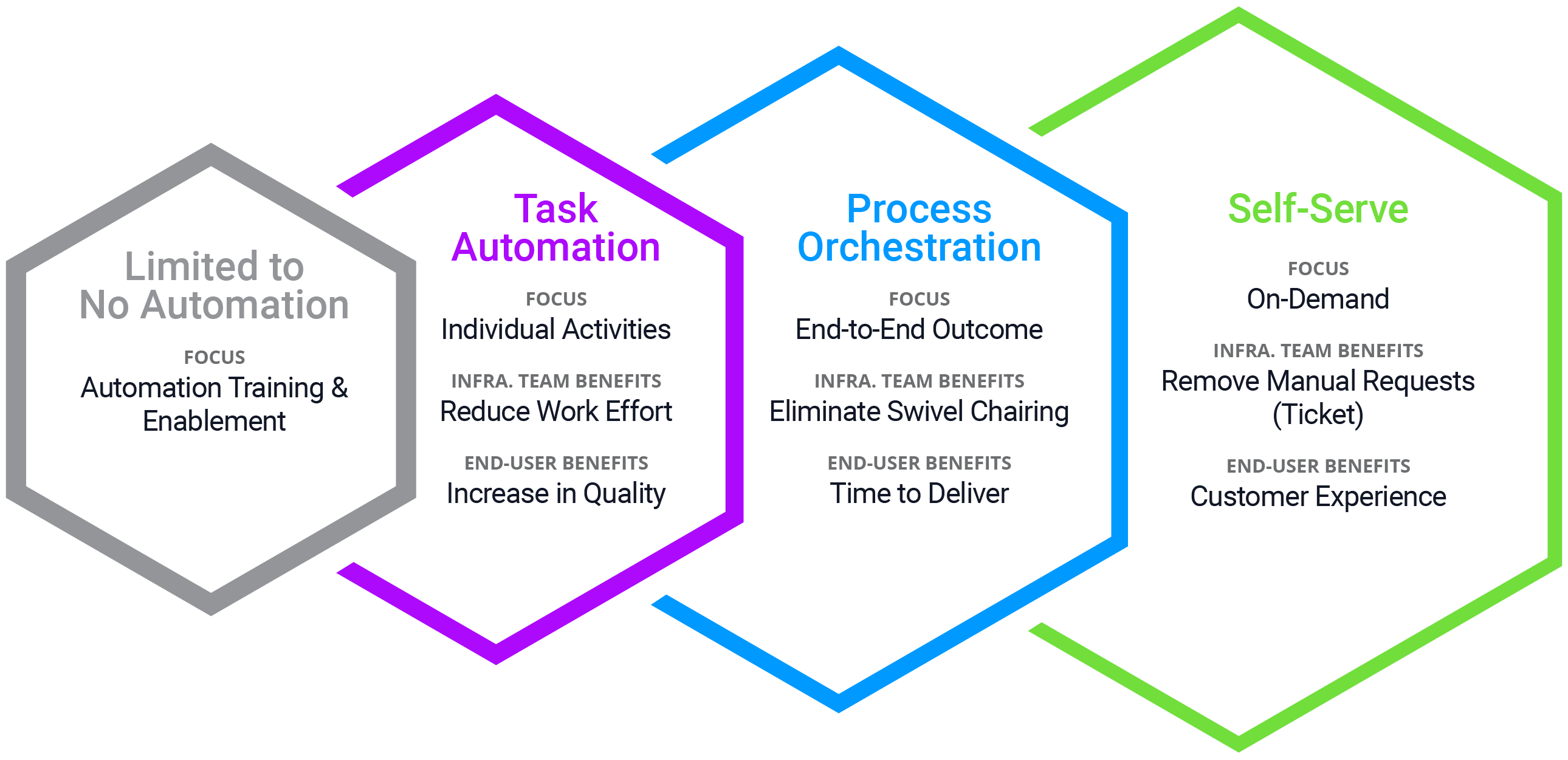
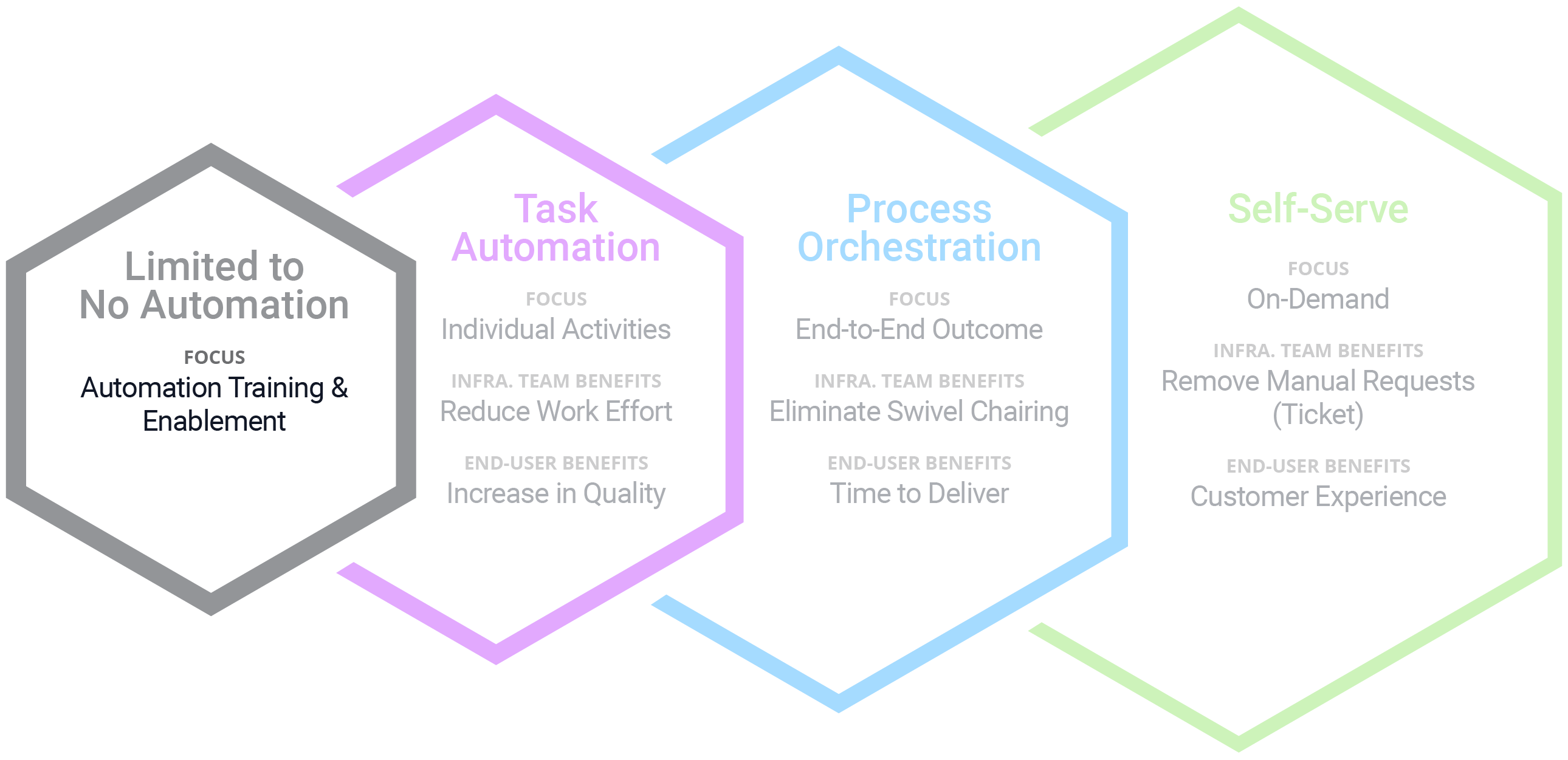
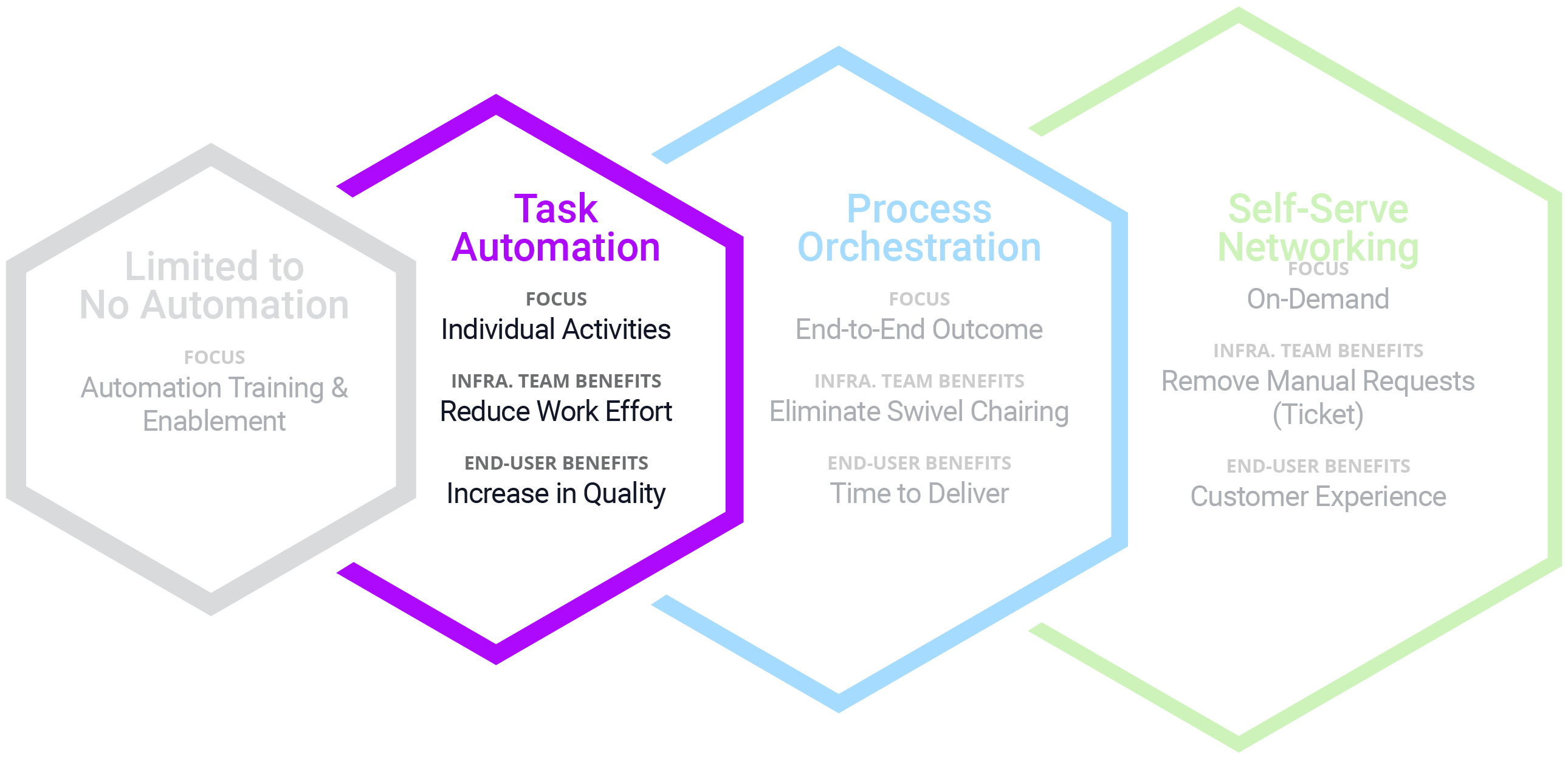
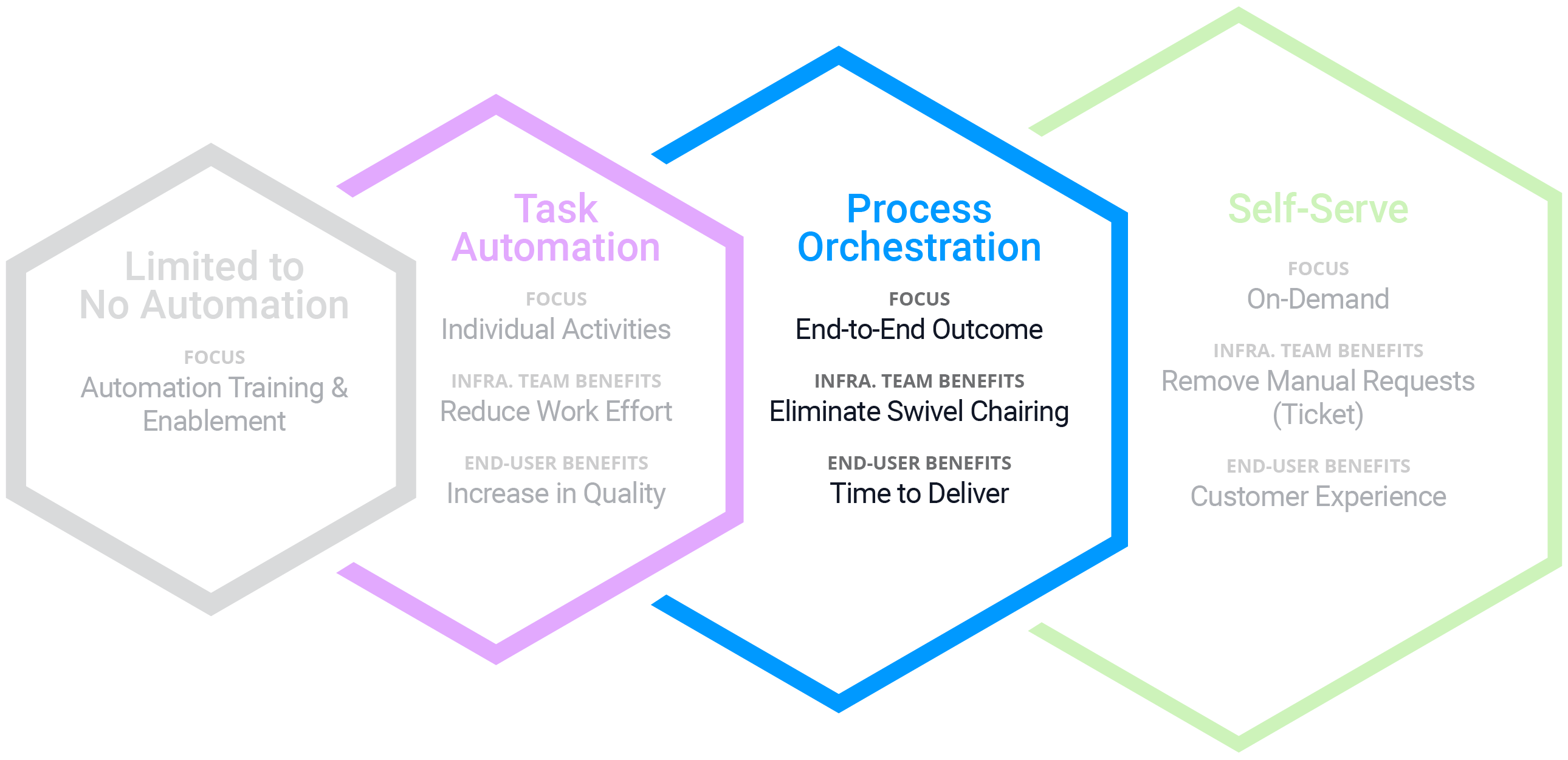
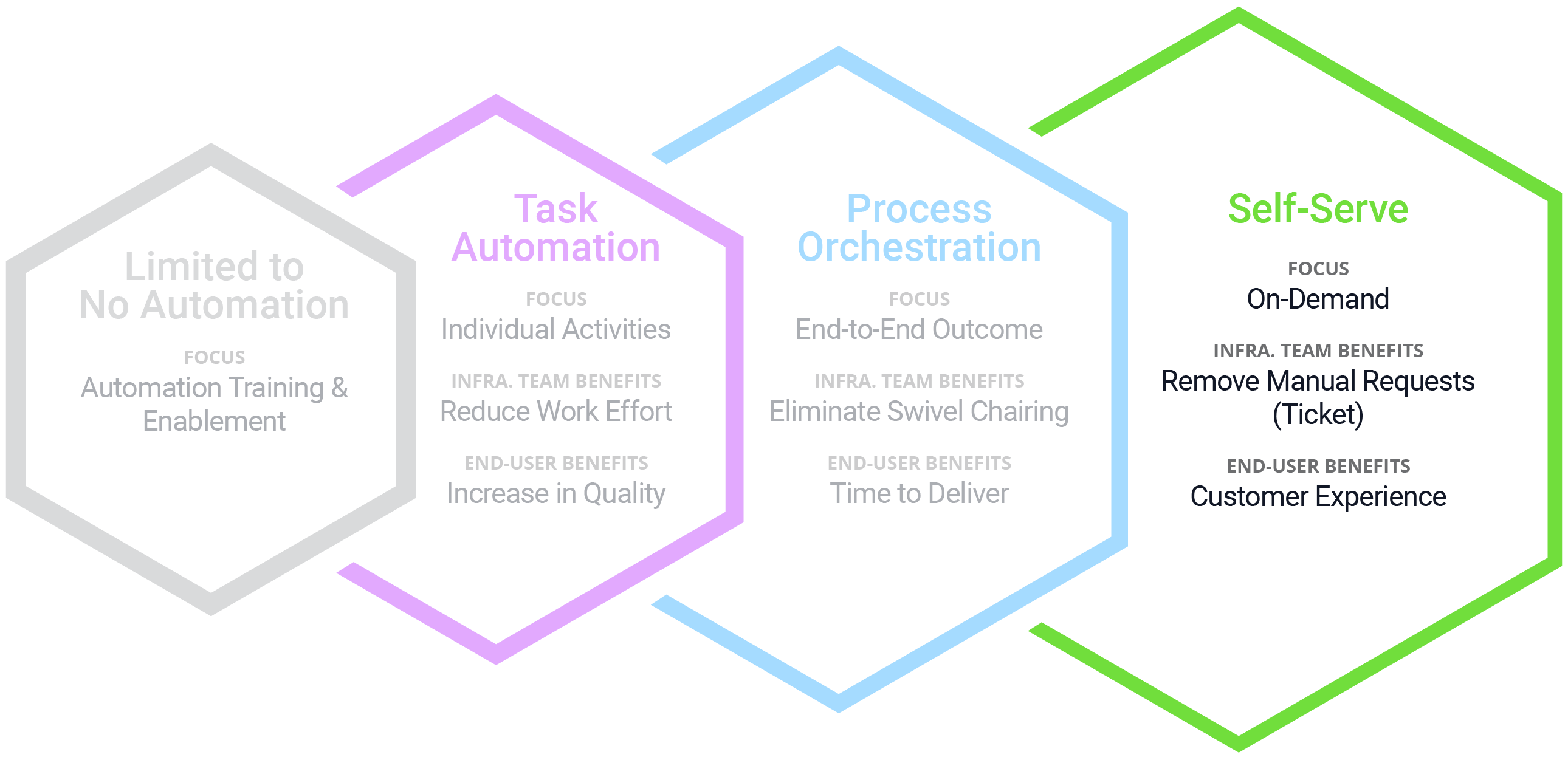
The Network Automation & Orchestration Maturity Model is a framework developed by Itential to help organizations understand and evolve their network automation journey. It outlines four stages—Limited to No Automation, Task Automation, Process Orchestration, and Self-Serve Networking—each representing increasing levels of automation scope, benefits, and complexity. The model helps teams identify their current state, set automation goals, and plan practical steps for evolution. [Source]
What are the four stages of automation maturity described by Itential?
The four stages are: 1) Limited to No Automation (manual processes, little to no automation), 2) Task Automation (engineers automate routine tasks with scripts), 3) Process Orchestration (end-to-end automation of network changes and integration with ITSM), and 4) Self-Serve Networking (network services are exposed for self-service consumption by IT and business users, enabling cloud-like delivery). [Source]
How can organizations assess their current automation maturity?
Organizations can assess their maturity by evaluating their people, skills, team structure, current automation practices, and the degree of automation adoption across teams. The model encourages identifying where individuals and teams fall within the four stages and using this insight to set realistic automation goals and strategies. [Source]
What are the main benefits of progressing through the automation maturity stages?
Progressing through the stages delivers increasing benefits: faster service delivery, reduced manual effort, improved consistency, greater scalability, and the ability to deliver network services as self-serve, cloud-like experiences. This evolution decouples network change volume from headcount and enables organizations to innovate more rapidly. [Source]
What challenges do organizations face at the early stages of automation maturity?
Common challenges include cultural hesitance, lack of automation skills, misconceptions about the cost and value of automation, and reliance on manual processes. Teams may also believe that using vendor controllers or ClickOps is sufficient, delaying broader automation adoption. [Source]
How does Itential help organizations evolve their automation maturity?
Itential provides a unified, low-code automation platform that supports users at any stage of maturity. The platform enables codeless onboarding of scripts, modular workflow building, and seamless integration with IT and network systems, helping teams move from ad hoc scripting to process orchestration and self-serve networking. [Source]
Is a single source of truth required for network automation?
No, a single source of truth is not required. The model emphasizes that infrastructure is distributed and sources of truth are often federated across domains. Attempting to consolidate all data can lead to outdated information. Successful orchestration involves federating sources of truth and integrating with them as needed. [Source]
What is the role of self-serve networking in the maturity model?
Self-serve networking is the highest stage of maturity, where network services are exposed as APIs or microservices for consumption by IT and business users. This enables cloud-like delivery, maximizes automation consumption, and decouples work output from headcount, allowing organizations to scale efficiently. [Source]
How can engineers and IT leaders contribute to automation evolution?
Engineers can start by automating repetitive tasks, learning scripting and APIs, and sharing automation assets. IT leaders should invest in skills development, foster a culture of automation, and select platforms that support modular, reusable automation and integration with existing systems. [Source]
What are the key takeaways for organizations using the maturity model?
Key takeaways include: assess your current state, set clear automation goals, understand the costs and benefits of progressing, involve stakeholders, and develop a practical 3-5 year plan for automation evolution. The model provides a roadmap for achieving tangible business outcomes through automation. [Source]
Features & Capabilities
What are the core features of the Itential Automation Platform?
The Itential Automation Platform offers low-code workflow automation, configuration management, 300+ pre-built integrations, self-service operations, an automation gateway for managing scripts and playbooks, compliance-native features like drift detection, and AI-ready architecture for integrating with AI platforms. [Source]
Does Itential support integration with existing IT and network tools?
Yes, Itential supports over 300 pre-built integrations with tools such as ServiceNow, NetBox, Infoblox, GitHub, Selector AIOps, Kentik, Forward Networks, IP Fabric, Red Hat Ansible, Terraform, Slack, Microsoft Teams, Arista Networks, Cisco, F5, and Palo Alto. This enables seamless orchestration across diverse environments. [Source]
How does Itential enable low-code automation?
Itential provides a drag-and-drop workflow builder that allows both technical and non-technical users to create, test, and execute automated workflows without needing to write code. This lowers the barrier to entry and accelerates automation adoption. [Source]
What compliance and governance features are built into Itential?
Itential includes role-based access control (RBAC), single sign-on (SSO), encryption for data in transit and at rest, audit trails, compliance automation for standards like PCI, HIPAA, NIST, and ISO, and automated drift detection and remediation. [Source]
How does Itential support AI-driven automation?
Itential's AI-ready architecture integrates with AI platforms, enabling governed and auditable actions based on AI insights. The FlowAI agent builder and MCP control layer translate AI intent into governed workflows, ensuring policy, audit, and compliance controls are enforced. [Source]
What technical documentation and resources are available for Itential?
Itential provides comprehensive documentation, developer tools, API references, and release notes. Resources are available at docs.itential.com, developer tools, and API documentation. Release notes are also published regularly.
Use Cases & Benefits
Who can benefit from using Itential?
Itential is designed for cloud network engineers, NetOps teams, DevOps teams, infrastructure architects, and compliance/SecOps teams. Industries that benefit include telecommunications, financial services, healthcare, manufacturing, public sector, utilities, media & entertainment, biotechnology, and energy. [Source]
What business impact can organizations expect from Itential?
Organizations using Itential have reported a 10x increase in operational agility, 85% reduction in change-related incidents, 70% reduction in infrastructure operations costs, faster service delivery (from 45 days to same day), and reduced time-to-value for new services (from 18 months to 3 months). [Source]
What problems does Itential solve for network teams?
Itential addresses fragmented automation and tool sprawl, manual change execution, configuration drift and non-compliance, multi-domain complexity, inability to scale operations, lack of governance and auditability, and slow adoption of automation due to coding barriers. [Source]
How does Itential help organizations scale automation without increasing headcount?
Itential's low-code design, pre-built integrations, and self-service catalogs enable organizations to automate and orchestrate processes across domains, reducing manual effort by 80-90% and allowing teams to scale operations without proportional increases in staff. [Source]
What feedback have customers given about Itential's ease of use?
Customers have praised Itential for its low-code design and intuitive interface. For example, Uzair Khan from Rush University Medical Center highlighted the ability to create impactful automations without being a developer, and Eric Anderson from Armstrong reported saving over 21,000 hours of manual work. [Source]
Implementation & Support
How long does it take to implement Itential?
Itential's Professional Services typically help customers go from contract signature to a production-ready platform with active use cases in 3-6 months. Initial value can be seen within weeks, and automation capabilities can expand rapidly over 6-12 months. [Source]
What resources are available to help new users get started with Itential?
New users can access a structured onboarding program, a 6-8 week activation program, interactive product tours, training and certification via Itential Academy, comprehensive documentation, and professional services for expert assistance. [Source]
Where can I find sample adapter configuration properties for Itential integrations?
Sample properties for configuring adapters such as Riverbed SteelConnect, Morpheus, and Confluence Cloud are available on the Itential website. Each sample includes fields for host, port, authentication, and other required parameters. [Source]
Security & Compliance
What security and compliance certifications does Itential have?
Itential holds SOC 2 Type II Certification, is FIPS 140-2 compliant, and adheres to GDPR and CCPA for data privacy. These certifications demonstrate Itential's commitment to security, availability, confidentiality, and processing integrity. [Source]
How does Itential ensure auditability and traceability?
Itential logs every change with comprehensive details, including pre/post validation results, user actions, approval chains, and timestamps. This provides full traceability for audits and compliance verification. [Source]
Does Itential support public sector and air-gapped deployments?
Yes, Itential supports on-premises and air-gapped deployments, ensuring data remains within secure environments and enabling compliance with mandates such as STIGs. [Source]
Competition & Comparison
How does Itential differ from other network automation platforms?
Itential stands out with its vendor-agnostic, multi-domain orchestration, low-code accessibility, integration-first approach, compliance-native features, and AI-ready design. It is ideal for enterprises with complex, multi-vendor infrastructures and regulated industries requiring strong governance. [Source]
What are the advantages of Itential for different user segments?
Network engineers benefit from low-code tools, IT leadership gains operational visibility and risk reduction, enterprises manage diverse environments effectively, and regulated industries ensure compliance with built-in governance. [Source]
Why should a customer choose Itential over other solutions?
Customers choose Itential for its ability to unify automation across physical, SD-WAN, cloud, and hybrid environments; its low-code accessibility; 300+ integrations; compliance-native features; measurable business impact; and ease of use for both technical and non-technical users. [Source]
Technical Requirements & Adapter Configuration
Can you provide sample properties for configuring the Riverbed SteelConnect adapter?
Yes, sample properties for the Riverbed SteelConnect adapter include fields for host, port, base_path, authentication method, healthcheck, throttle, request, proxy, SSL, and devicebroker settings. These samples are available on the Itential website and should be customized for your environment. [Source]
Can you provide sample properties for configuring the Morpheus adapter?
Yes, sample properties for the Morpheus adapter include host, port, base_path, authentication method (request_token), healthcheck, throttle, request, proxy, SSL, and devicebroker settings. These should be tailored to your specific environment. [Source]
Where can I find sample properties for configuring the Confluence Cloud adapter?
Sample properties for the Confluence Cloud adapter are available on the Itential website. They include host, port, base_path, authentication, healthcheck, throttle, request, proxy, SSL, and devicebroker settings. Update these fields for your environment. [Source]