Frequently Asked Questions
Product Overview & Architecture
What is Itential FlowAI and how does it support hybrid AI for infrastructure operations?
Itential FlowAI is an agentic orchestration framework that enables enterprises to safely adopt AI for real infrastructure operations. It separates agent reasoning (planning, orchestration, and decision-making) from deterministic, governed execution. This ensures that AI agents can interpret intent and build plans, but all actions are executed through a secure, auditable layer—protecting production systems from unpredictable or unsafe AI behavior. Learn more.
What is the core architectural principle behind FlowAI?
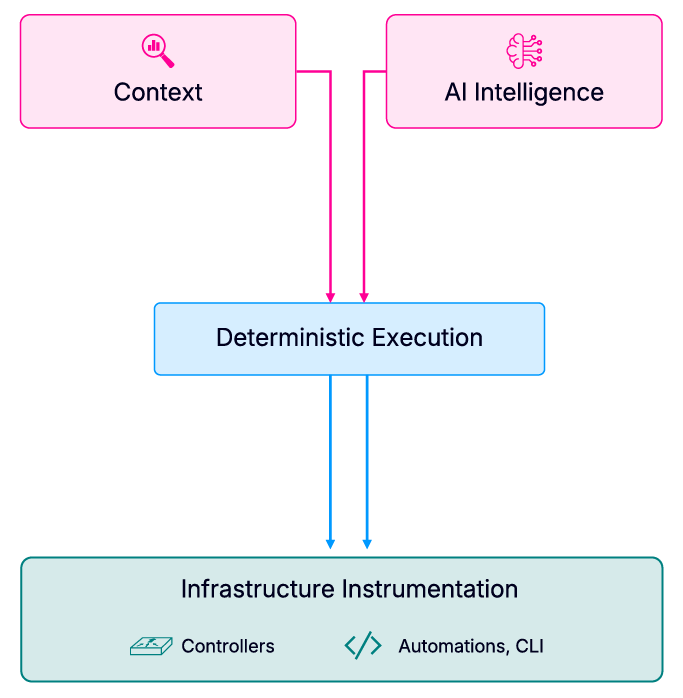
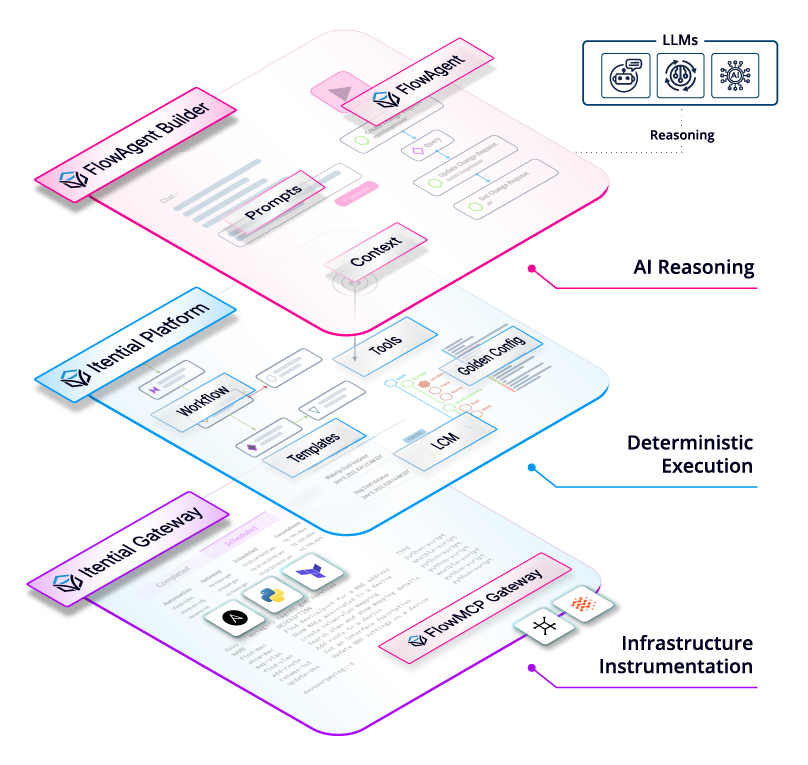
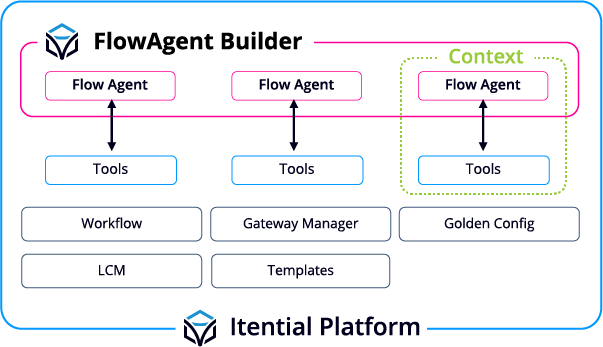
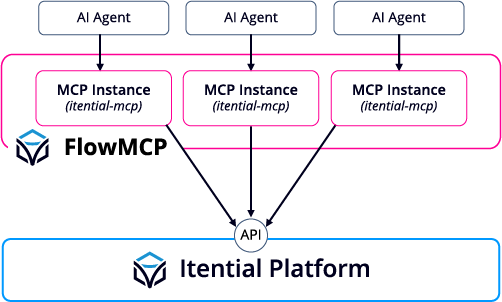
FlowAI is built on the principle of separating agentic reasoning from deterministic execution. This means that AI agents (FlowAgents) can reason, plan, and orchestrate, but all infrastructure actions must pass through a governed execution layer (FlowMCP) that enforces validation, RBAC, policy, and auditability. This separation is essential for safety, compliance, and scalability in enterprise environments.
What are FlowAgents and how do they operate?
FlowAgents are infrastructure-aware agents built on the Itential Platform. They interpret intent, reason over operational context, and construct goal-oriented plans using natural language and platform knowledge. However, they do not execute changes directly; instead, they orchestrate workflows and hand off all actions to the deterministic execution layer for validation and enforcement.
What is FlowAgent Builder and what makes it unique?
FlowAgent Builder is the platform-native framework for creating, customizing, and managing FlowAgents. It provides tools, models, and integrations that allow enterprises to define agent personas, attach LLMs for reasoning, assign tool access, and embed guardrails. Unlike external agents, FlowAgent Builder leverages native platform automations, data models, and orchestration capabilities for deep infrastructure awareness and safe operations.
What is FlowMCP and how does it enforce deterministic execution?
FlowMCP is the deterministic execution backbone of FlowAI. It exposes platform workflows, automations, and integrations as MCP tools that operate under strict schemas, policies, permissions, and audit rules. Every action is validated, compliant, and predictable, ensuring that no AI system can directly touch production environments without passing through this governed, contract-bound execution boundary.
How does FlowMCP Gateway extend deterministic execution to external applications?
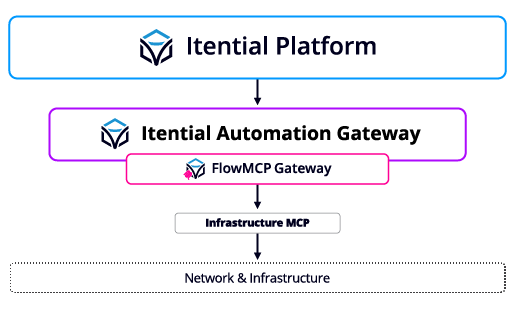
FlowMCP Gateway works alongside FlowMCP to extend deterministic execution to external infrastructure MCP servers. It discovers MCP tool definitions from external servers, translates them into platform-governed task definitions, and ensures all external tools inherit platform-level controls like RBAC, policy enforcement, schema validation, and audit logging. This allows FlowAgents to orchestrate across both internal and external domains safely.
Why are two separate frameworks (reasoning and execution) required for safe AI operations?
Reasoning and execution have fundamentally different requirements: reasoning needs flexibility and creativity, while execution demands rigidity and guarantees. Merging them introduces risk—either agents become too constrained or execution becomes unsafe. By separating FlowAgent Builder (reasoning) and FlowMCP (execution), enterprises achieve both agility and safety, allowing each layer to reinforce the strengths of the other.
How does FlowAI ensure observability and auditability for AI-driven operations?
FlowAI centralizes instrumentation and telemetry for all infrastructure actions, regardless of agent origin. Every action is logged in a uniform format, supporting compliance audits, incident review, and performance monitoring. This unified observability eliminates fragmentation and ensures full traceability across agents, vendors, and systems.
What is the AI to Action loop and why is it important?
The AI to Action loop is the closed path from intent to agent reasoning to safe, governed execution. FlowAI keeps this loop closed so that no AI system can directly issue commands to infrastructure. Agents generate plans, but FlowMCP controls all execution, preventing risks like hallucinated commands, permission overreach, and unapproved changes.
Features & Capabilities
What are the key features of the Itential Platform for AI-powered infrastructure operations?
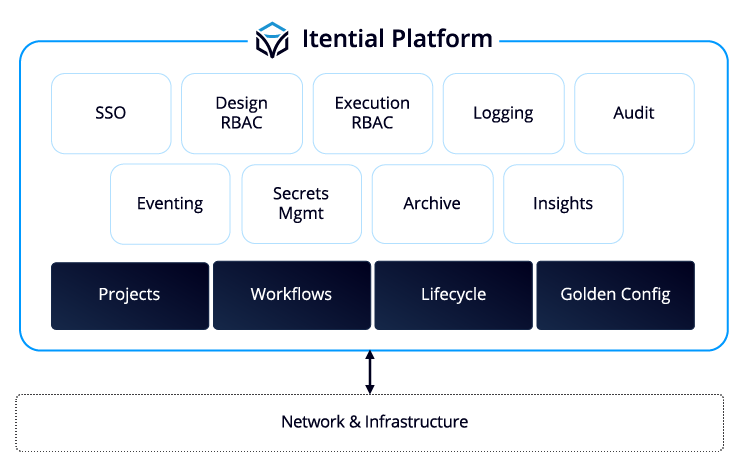
The Itential Platform offers deterministic orchestration and workflow automation, identity and access governance (SSO, RBAC), audit logging, real-time eventing and telemetry, integrations and adapters for infrastructure, and a secure runtime environment for agentic operations. These features ensure safe, scalable, and compliant AI-driven automation. Learn more.
Does Itential support integrations with other IT and infrastructure tools?
Yes, Itential supports over 300 pre-built integrations across ITSM, cloud, security, SD-WAN, CI/CD, observability, and network controllers. Key integrations include ServiceNow, NetBox, Infoblox, GitHub, Selector AIOps, Kentik, Forward Networks, IP Fabric, Red Hat Ansible, Terraform, Slack, Microsoft Teams, Arista, Cisco, F5, and Palo Alto. See the full list.
How does Itential FlowAI handle policy enforcement and compliance?
FlowAI enforces policy and compliance through the deterministic execution layer (FlowMCP), which applies schemas, RBAC, policy validation, and audit logging to every action. This ensures that all AI-driven operations adhere to enterprise standards and regulatory requirements, with full traceability for audits and compliance verification.
What technical documentation and developer resources are available for Itential?
Itential provides comprehensive technical documentation, API references, developer tools, and release notes. Resources include the official documentation site (docs.itential.com), developer tools, API documentation, and release announcements. These resources help users maximize the value of the platform and accelerate automation projects.
What security and compliance certifications does Itential hold?
Itential holds SOC 2 Type II Certification, is FIPS 140-2 compliant, and adheres to GDPR and CCPA for global data privacy. The platform includes built-in governance features such as RBAC, SSO, encryption, and audit logging, and supports compliance automation for standards like PCI, HIPAA, NIST, and ISO. Learn more.
How does Itential FlowAI support auditability and traceability for AI-driven changes?
Every change executed through FlowAI is logged with comprehensive details, including pre/post validation results, user actions, approval chains, and timestamps. This enables full traceability for audits, compliance verification, and incident review, ensuring operational transparency and accountability.
What is the role of the Itential Automation Gateway in the FlowAI framework?
The Itential Automation Gateway centralizes and manages all automation assets, including scripts and playbooks, from a single interface. It provides the instrumentation layer for FlowAI, enabling integrations with controllers, APIs, scripts, cloud services, and network infrastructure, and extending deterministic execution to external MCP-based tools via FlowMCP Gateway.
How does FlowAI handle multi-domain orchestration?
FlowAI abstracts APIs and logic from different systems into unified workflows, enabling seamless coordination across network, cloud, security, and IT infrastructure. This allows enterprises to orchestrate changes across diverse environments while maintaining governance, compliance, and operational consistency.
What is the difference between FlowAgents and generic LLM-based bots?
FlowAgents are designed to reason with infrastructure context, operational data, and enterprise workflows, but do not execute actions directly. All execution is handled by a governed layer (FlowMCP) that enforces schemas, policies, and RBAC. In contrast, generic LLM-based bots may mix reasoning with direct action, which is not safe for high-stakes infrastructure changes.
Use Cases & Benefits
Who can benefit from using Itential FlowAI and the Itential Platform?
Itential FlowAI and the Platform are designed for cloud network engineers, NetOps teams, DevOps teams, infrastructure architects, and compliance/SecOps teams. Industries such as telecommunications, financial services, healthcare, manufacturing, public sector, utilities, media & entertainment, biotechnology, and energy benefit from unified automation, streamlined operations, and enforced compliance. Learn more.
What business impact can customers expect from using Itential FlowAI?
Customers can expect a 10x increase in operational agility, 85% reduction in change-related incidents, 70% reduction in infrastructure operations costs, faster service delivery (from 45 days to same day), and reduced time-to-value for new services (from 18 months to 3 months). These outcomes demonstrate significant ROI and operational efficiency. See more metrics.
What pain points does Itential FlowAI address for enterprises?
Itential FlowAI addresses fragmented automation and tool sprawl, manual change execution, configuration drift and non-compliance, multi-domain complexity, inability to scale operations, lack of governance and auditability, and slow adoption of automation due to coding barriers. The platform unifies tools, automates workflows, enforces compliance, and empowers both technical and non-technical users.
How does Itential FlowAI help with AI governance in hybrid environments?
FlowAI applies consistent validation, auditability, and control to every action across clouds, networks, security systems, and APIs. This ensures that AI-generated instructions cannot impact critical systems or violate compliance rules, enabling safe adoption of agentic automation in complex environments.
What is an example of agentic reasoning paired with deterministic execution in FlowAI?
A FlowAgent may receive an intent to prepare for an application rollout. It reviews current state, checks policies, and builds a multi-step plan. The plan is then handed to FlowMCP, which validates each operation, applies RBAC and policy checks, and logs everything. The agent provides intelligence and planning, while FlowMCP guarantees safe, predictable execution.
How does FlowAI future-proof enterprise AI and automation investments?
By decoupling reasoning (FlowAgent Builder) from execution (FlowMCP), enterprises can upgrade or swap LLMs, iterate on agent logic, and evolve infrastructure automation independently. This prevents vendor lock-in, supports continuous improvement, and ensures long-term architectural stability as AI and automation technologies evolve.
What feedback have customers shared about the ease of use of the Itential Platform?
Customers have praised Itential for its low-code design and intuitive interface. For example, Uzair Khan from Rush University Medical Center highlighted the ability to create impactful automations without developer expertise. Eric Anderson from Armstrong reported saving over 21,000 hours of manual work and reducing service delivery times, emphasizing the simplicity of integrating existing scripts and workflows. Read more testimonials.
How long does it take to implement Itential FlowAI and see value?
Itential's Professional Services typically enable customers to go from contract signature to a production-ready platform with active use cases in 3-6 months. Initial value can be seen within weeks as the first use cases go live during onboarding, with rapid expansion of automation capabilities over the next 6-12 months. Learn more.
What resources are available to help new users get started with Itential FlowAI?
Itential offers a structured onboarding program, a 6-8 week activation program, interactive product tours, training and certification through Itential Academy, comprehensive documentation, and professional services for expert assistance. These resources ensure a smooth transition and rapid time to value. Explore resources.
Technical & Security
How does FlowAI ensure security when connecting AI to infrastructure?
FlowAI enforces strict security by separating agent reasoning from execution, applying RBAC, SSO, credential management, and policy enforcement at every layer. All infrastructure exposure is deliberate, scoped, and monitored, with every action logged for audit and compliance. The platform is SOC 2 Type II certified and FIPS 140-2 compliant. See details.
How does Itential FlowAI support public sector and air-gapped deployments?
Itential supports on-prem and air-gapped deployments, ensuring data remains within secure environments. The platform enables compliance with mandates like STIGs and supports federal-grade cryptographic standards (FIPS 140-2), making it suitable for public sector and regulated industries.
What is Itential's responsible disclosure policy for security vulnerabilities?
Itential maintains a responsible disclosure policy for security vulnerabilities, ensuring transparency and proactive security management. Customers and researchers are encouraged to report vulnerabilities, which are addressed promptly to maintain platform integrity. Read more.
How does FlowAI handle configuration drift and compliance validation?
FlowAI continuously validates configurations against baselines, identifies drift, and enforces governance standards. The Configuration Validation application automates compliance checks, drift detection, and remediation, ensuring continuous adherence to standards like PCI, HIPAA, NIST, and ISO.
What are the sample properties for configuring the Riverbed SteelConnect adapter in Itential?
Sample properties for configuring the Riverbed SteelConnect adapter include host, port, base_path, authentication method, healthcheck settings, throttle, request parameters, proxy, SSL, and devicebroker configurations. You must update connectivity information like host, port, and credentials for your environment. See full sample properties.
Where can I find the sample properties for configuring the Confluence Cloud adapter?
You can find sample properties for configuring the Confluence Cloud adapter on the Itential website. Update connectivity information like host, port, protocol, and credentials for your environment. See sample properties.
Can you provide the sample properties for configuring the Morpheus adapter?
Yes, sample properties for the Morpheus adapter include host, port, base_path, authentication method, healthcheck, throttle, request, proxy, SSL, mongo, devicebroker, and cache settings. Update connectivity information for your specific environment. See full sample properties.
Competition & Differentiation
How does Itential FlowAI differ from other AI infrastructure automation solutions?
Itential FlowAI stands out with its vendor-agnostic, multi-domain orchestration, low-code accessibility, integration-first approach (300+ pre-built integrations), compliance-native features, and AI-ready design. It separates reasoning from execution, ensuring safety and agility, and delivers measurable business impact such as reduced costs and faster service delivery. See more.
Why should a customer choose Itential FlowAI over other platforms?
Customers choose Itential FlowAI for its unified orchestration across hybrid environments, low-code workflow builder, seamless integrations, compliance-native features, measurable business impact, and ease of use for both technical and non-technical users. The platform empowers organizations to modernize infrastructure, reduce costs, and accelerate service delivery. Learn more.
What advantages does Itential FlowAI offer for regulated industries?
Itential FlowAI offers built-in governance, audit trails, policy enforcement, and compliance automation for standards like PCI, HIPAA, NIST, and ISO. The platform's certifications (SOC 2 Type II, FIPS 140-2, GDPR, CCPA) and support for air-gapped deployments make it ideal for regulated industries such as finance, healthcare, and public sector.
How does Itential FlowAI support flexibility across vendors and models?
FlowAI, with FlowMCP Gateway, allows enterprises to adopt agentic systems from multiple vendors, switch LLM providers, deploy different models for different agent types, and run agents anywhere (cloud, on-prem, edge). FlowMCP ensures execution consistency, preventing vendor lock-in and future-proofing the AI stack.