Frequently Asked Questions
Product Information
What is Itential's integration with Ansible?
Itential integrates with Ansible to enhance network automation and orchestration. By leveraging your Ansible Playbooks with Itential’s Automation Gateway and Platform, teams can manage, secure, and scale their automations, turning tactical scripts into orchestrated workflows that span multiple domains. Source
How does Itential's Automation Gateway support Ansible assets?
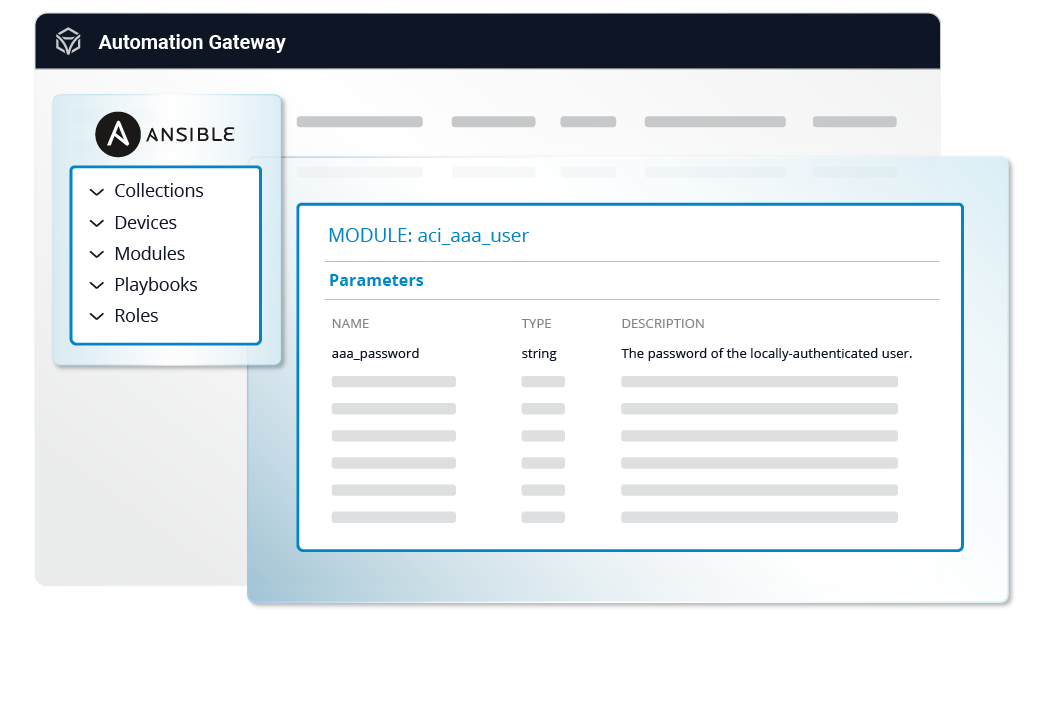
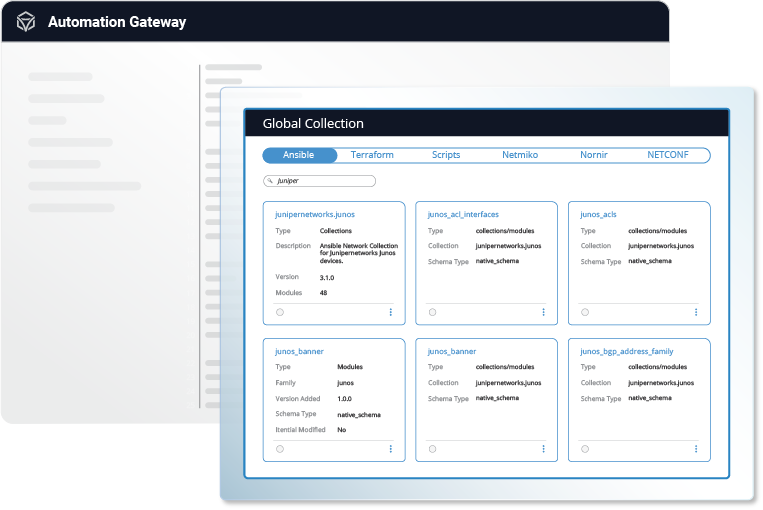
Itential Automation Gateway supports all your existing Ansible assets, including Modules, Playbooks, Roles, and Collections, as well as device inventory. It provides a secure central location for management, access control, search, and audit logging. Source
What is the benefit of centralizing Ansible assets with Itential?
Centralizing Ansible assets with Itential allows organizations to securely manage, organize, and share automations across teams. It ensures proper access control, auditability, and easy searchability, reducing manual overhead and improving collaboration. Source
How does Itential provide a secure execution environment for Ansible automations?
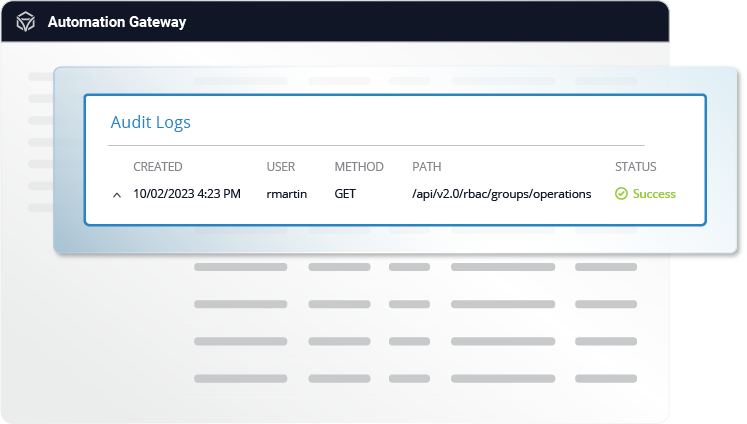
Itential integrates with LDAP systems for authentication, supports RBAC rules, logs every action for auditability, and secures sessions with encryption and vault services for secrets. Source
Can Ansible automations be accessed via API with Itential?
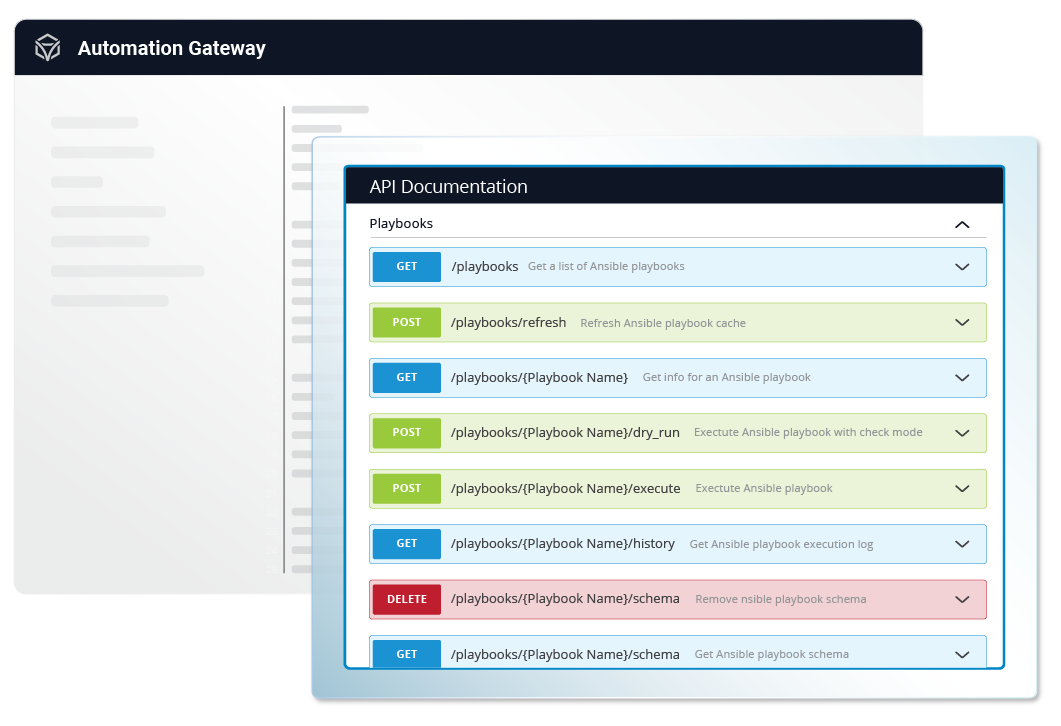
Yes, Itential enables secure REST API access to Ansible assets, allowing them to be utilized by other programs, platforms, and self-service portals such as ServiceNow. Source
How does Itential enable self-service for Ansible automations?
Itential allows teams to leverage Ansible automations within DevOps CI/CD pipelines or self-service portals, making automation accessible and scalable across the organization. Source
Can Itential manage other automation assets besides Ansible?
Yes, Itential supports onboarding other common automation assets such as Python and Terraform, enabling consolidated management and execution regardless of technology. Source
How does Itential expand Ansible use cases?
Itential’s orchestration capabilities enable organizations to automate network changes that cross multiple domains, integrating Ansible automations into larger workflows for greater scale and efficiency. Source
Can Ansible automations be visualized and built into orchestrated workflows with Itential?
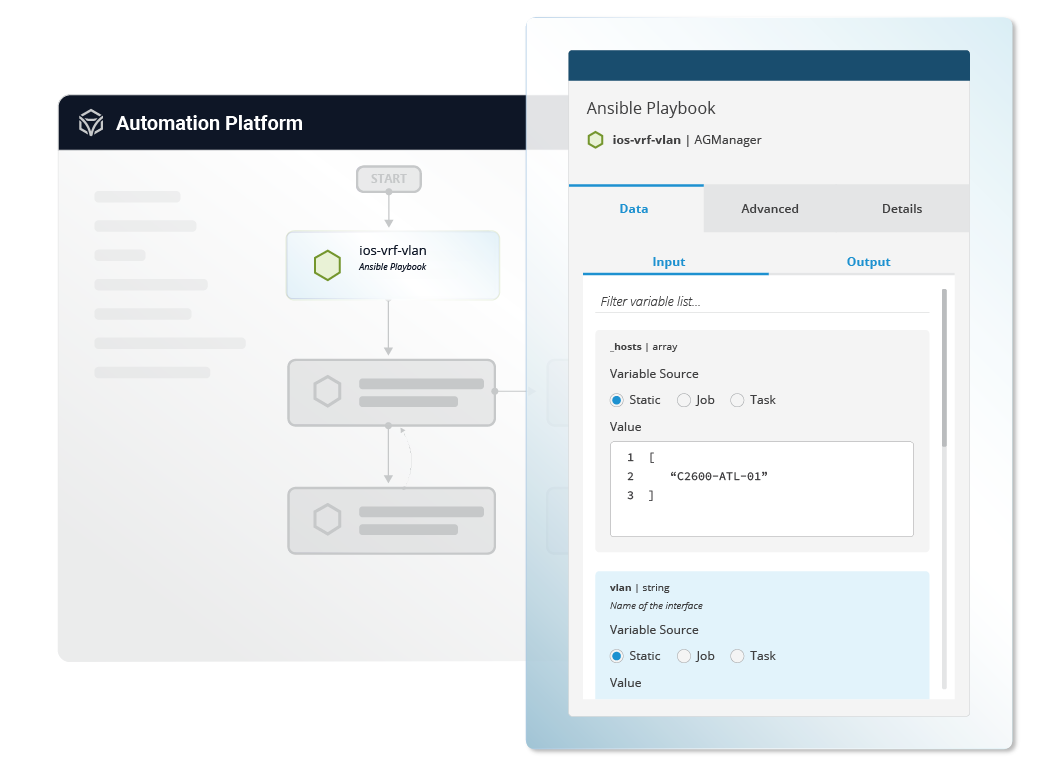
Yes, Itential provides a visual, low-code workflow canvas where Ansible automations can be integrated with cloud, network, and IT services, enabling end-to-end orchestration. Source
Does Itential integrate with Ansible Tower?
Yes, Itential Platform integrates with Ansible Tower, providing orchestration solutions for DevOps and NetOps teams, including visual dashboards, job scheduling, notifications, and inventory management. Source
How does Itential manage network inventory?
Itential creates and manages a next-generation network inventory engine that leverages a real-time federated data model, ensuring inventory is always up-to-date compared to traditional tools relying on cached or imported data. Source
Can Itential integrate with any IT system?
Yes, Itential integrates with any cloud or network solution and any IT system or service at the API level, enabling visual workflows that utilize Ansible automation alongside API methods from integrated systems. Source
How does Itential handle data integration for Ansible automations?
Itential’s visual Data Transformation feature allows users to extract and transform data from any system to pass to Ansible automations and use their output in workflows, without custom code. Source
What is the 'Bring Your Own Automation' concept in Itential?
The 'Bring Your Own Automation' concept allows organizations to onboard their existing automation assets, such as Ansible, Python, and Terraform scripts, into Itential’s platform, leveraging previous investments and scaling automation efforts. Source
How does Itential help democratize network automation?
Itential democratizes automation by providing a low-code platform that enables more people than just coders to participate. Its 'Bring Your Own Automation' approach integrates existing scripts into reusable workflows, making automation accessible and scalable across the organization. Source
Features & Capabilities
What are the key features of Itential's Automation Gateway for Ansible?
Key features include centralized management, access control, audit logging, secure execution, API accessibility, self-service enablement, and support for onboarding other automation assets. Source
How does Itential enhance Red Hat Ansible for network automation?
Itential provides a low-code, drag-and-drop interface that makes automation accessible to the entire network team, not just developers. It enables end-to-end automation across multiple domains and IT systems, offering a 'single pane of glass' for network automation. Source
What integrations does Itential support?
Itential supports over 300 pre-built integrations, including ServiceNow, NetBox, Infoblox, GitHub, Selector AIOps, Kentik, Forward Networks, IP Fabric, Red Hat Ansible, Terraform, messaging systems like Slack and Microsoft Teams, Arista Networks, Cisco, F5, and Palo Alto. Source
How does Itential enable rapid integration with IT and network systems?
Itential’s rapid integration capabilities eliminate costly integration efforts and enable robust orchestration flows, supporting no-code adapters and a growing library of integrations. Source
Can I build custom integrations with Itential?
Yes, Itential provides a no-code adapter builder, allowing users to build custom integrations with homegrown systems in minutes. Source
What technical documentation is available for Itential?
Itential offers comprehensive guides, API references, release notes, and developer tools. Official documentation is available at docs.itential.com, API docs at apidocs.itential.com, and developer tools at developer tools page. Source
How does Itential support auditability and compliance?
Itential logs every orchestration execution, including who initiated it, what changed, approval chain, and timestamps, creating complete operational records automatically for compliance and auditability. Source
What are the compliance certifications for Itential?
Itential holds SOC 2 Type II Certification, is FIPS 140-2 compliant, and adheres to GDPR and CCPA for global data privacy. Source
How does Itential automate compliance checks and remediation?
Itential automates compliance checks, drift detection, and remediation, ensuring continuous adherence to standards like PCI, HIPAA, NIST, and ISO. Source
Use Cases & Benefits
Who can benefit from using Itential with Ansible?
Cloud network engineers, NetOps teams, DevOps teams, infrastructure architects, compliance and SecOps teams, and organizations in industries such as telecommunications, financial services, healthcare, manufacturing, public sector, utilities, media & entertainment, biotechnology, and energy can benefit from Itential’s integration with Ansible. Source
What business impact can customers expect from using Itential?
Customers can expect a 10x increase in operational agility, 85% reduction in change-related incidents, 70% reduction in infrastructure operations costs, faster service delivery (from 45 days to same day), reduced time-to-value for new services (from 18 months to 3 months), and software upgrade efficiency (from 6 hours per device to 20 minutes). Source
What feedback have customers given about Itential's ease of use?
Customers praise Itential for its low-code design and intuitive interface. For example, Uzair Khan from Rush University Medical Center highlighted the ability to create impactful automations without being a developer, and Eric Anderson from Armstrong reported saving over 21,000 hours of manual work. Source
What problems does Itential solve for network automation teams?
Itential solves fragmented automation and tool sprawl, manual change execution, configuration drift and non-compliance, multi-domain complexity, inability to scale operations, lack of governance and auditability, and slow adoption of automation. Source
How long does it take to implement Itential?
Itential’s Professional Services enable organizations to go from contract signature to production-ready platform with active use cases in 3-6 months. Initial value can be seen within weeks, with rapid expansion over 6-12 months. Source
How easy is it to start using Itential?
Itential offers structured onboarding and activation programs, interactive product tours, training and certification via Itential Academy, comprehensive documentation, and professional services to ensure rapid adoption and early wins. Source
Does Itential offer solutions for specific industries?
Yes, Itential provides tailored automation solutions for financial services, public sector, manufacturing, communications service providers, healthcare, energy & utilities, and more. Source
Where can I find information about Itential's solutions for the public sector?
Information about Itential's public sector solutions is available on our public sector page and Carahsoft's Itential solutions page. Source
Competition & Comparison
How does Itential differ from similar products in the market?
Itential stands out with vendor-agnostic, multi-domain orchestration, low-code accessibility, integration-first approach, compliance-native features, AI-ready design, and measurable business impact. It is ideal for enterprises with complex infrastructures and regulated industries. Source
How does the Red Hat Ansible Automation Platform (AAP+) compare to the community version of Ansible?
AAP+ offers enterprise-grade enhancements: LDAP/SAML/SSO integration, credential security, scheduled and approval workflows, team-based RBAC, audit trails, high availability, certified content collections, and analytics. Community Ansible lacks these features and is best for smaller teams or tactical automation. Source
What is the typical ROI timeline for implementing Red Hat Ansible Automation Platform (AAP+)?
The value realization for AAP+ follows a phased timeline: -40% ROI in first two quarters (investment phase), -10% in Q3-Q4, +25% in Q5-Q6, +65% in Q7-Q8, and +120% ROI in mature practice (Q9+). Source
Do DevOps/NetOps tools like Ansible solve the problems of script-based automation?
While tools like Ansible, Puppet, or SaltStack provide automation at scale, they require significant time investment to learn their languages and often remain focused only on network changes, not end-to-end operational procedures. This can result in a few experts being responsible for all automations. Source
How does Ansible work and what are its typical use cases in network automation?
Ansible uses Python to build 'playbooks' that automate inventory and device configuration data collection. Typical use cases include automating configuration of routers or firewalls at scale in a standardized manner. Source