...
Itential Platform Pricing Explore flexible plans and options for your team

Itential logo
Blogs

Introducing Work Center: Keeping Humans in Control as Agents Take Action

Elliot Chen
Senior Product Manager

Quick Summary

  • As agents begin to reason and act on infrastructure on their own, the question that follows is where you stay in control. This blog introduces Work Center, a new Itential Platform application that gives you one queue for every human decision, whether a workflow or a FlowAgent raised it, with the full context to act. It covers what’s inside, including the new Quick Form task type, compatibility with the manual tasks you already run, and an automatic audit trail, plus why a dedicated human surface matters now that automation can act without waiting to be told. Work Center is available with Itential Platform 6.5, on cloud and on-premises, for every team on the platform.

Automation is starting to think for itself. With the launch of Itential FlowAI, agents on the Itential Platform reason through goals and take action on real infrastructure, choosing their own path at runtime instead of following a fixed script. That is a step change in what automation can do. It also raises the oldest question in operations: where do people stay in control?

More autonomy does not mean less human judgment. It means the moments that call for a person, an approval, a review, a decision before something irreversible happens, matter more, not less. Agents reach those moments on their own now, just as workflows always have. Someone still has to make the call.

Today we are shipping Work Center. The place where they make it.


One Decision, However the Automation Got There

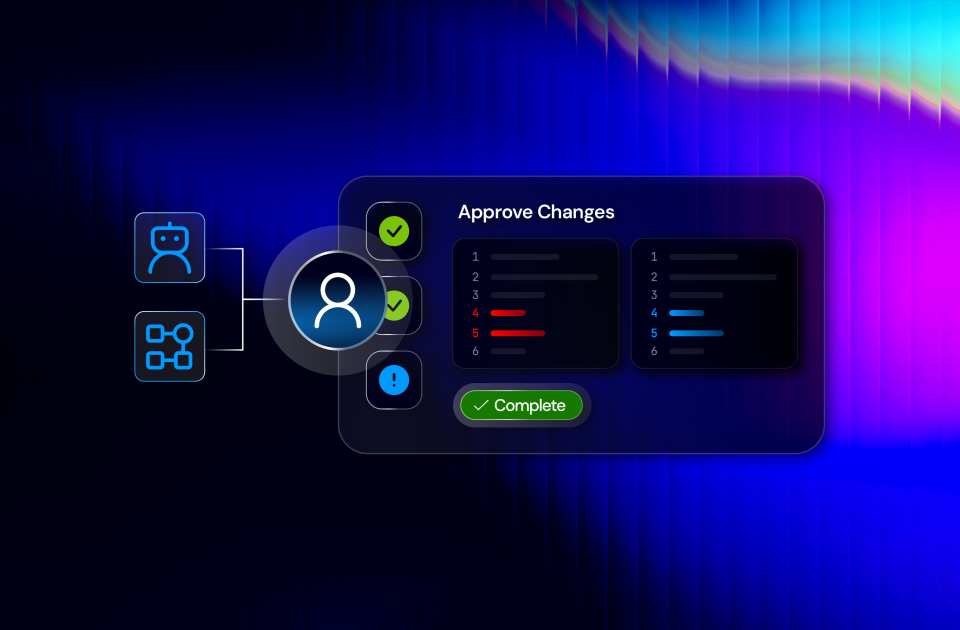
Work Center gives every human-in-the-loop moment the same simple experience, no matter how autonomous or intricate the automation underneath it. Open it, and you see only what is waiting on you: what triggered the task, how long it has been waiting, and what happened before it reached you. No job graph to untangle, and no need to know whether the task came from a workflow step or a FlowAgent’s reasoning.

Here is what that looks like. A decision reaches a person. Behind it, a FlowAgent worked through a goal, called a couple of workflows, looped in another agent, ten steps deep. The operator does not audit that chain to act. They see one task: approve or reject, with the context that matters. However far the automation ran on its own, the decision, and the control, stays with a person.

That is the point of Work Center. And with agents now acting on their own, it matters more than ever.

Why This Matters Now

Two kinds of automation run on the platform, and they work together. Deterministic workflows, built step by step in Studio, have always had human checkpoints. FlowAgents, new with this release, reason at runtime and decide their own path, and they reach human checkpoints too. Neither stays in its lane. A workflow can hand a decision it cannot pre-script to an agent. An agent can call a workflow as a tool. Either can call the other several layers deep.

Agents are what make a dedicated human surface urgent. When automation can act on its own, those human checkpoints become the control surface: the points where a person confirms intent before the system proceeds. They deserve more than a task buried in an admin console. They deserve a place built for the decision. Work Center serves both models the same way: the workflow tasks operators have always had, and the agent-originated ones that are new today.

Inside Work Center

A Single Queue

Every task waiting on a human, in one place. Filter by what is assigned to you, what is unassigned, or everything at once. Sort by how long a task has been waiting, so the work that matters most rises to the top.

The Full Context to Act

Open a task and you get a work item header, a timeline of every manual step in the job (completed and active), and the decision itself, front and center. Completed steps show who handled them and when. Finish a task, and when the workflow produces the next one, the view updates on its own. No trip back to the queue.

Quick Form, for Structured Decisions

Some decisions are not a single yes or no. Quick Form is a new task type that renders any dataset as a table where each row takes structured input: a text field, a checkbox, or a dropdown whose options you define, whether that is approve or reject or anything else the decision calls for. Point it at a static list, or at the set of recommendations a FlowAgent just generated, and the operator gets the same clean, guided table either way. It’s a purpose-built alternative to the JSON Form workarounds teams have been living with, and it’s built for the agent-and-workflow world from day one.

Works With What You’ve Already Built

Work Center is not a fresh start. Most existing manual tasks are compatible with it, so the workflows you already run keep working out-of-thebox, and the human steps you have already designed simply show up in the queue. That same library of task types is available to FlowAgents from day one. When an agent needs a human decision, it can reach for the manual tasks your team already knows, with nothing new to build.

Every Decision, On The Record

Every action in Work Center is logged automatically: who decided, and when. Human control is not worth much if you cannot show how it was exercised, so the audit trail is not a separate report to generate later. It is attached to the job, ready the moment anyone needs to look back.

Built for This, Not Bolted On

Approval steps are not new. Most automation tools bolt on an approval inbox, or lean on a separate ticketing system, to handle the human moments. That was workable when automation only did what it was told. It is not enough when automation reasons and acts on its own. Work Center is the native operator surface for the Itential Platform, built so people keep meaningful control as workflows and agents call each other freely, and so the person making the call never pays for that complexity in confusion.

The Bottom Line

Work Center gives operators a focused, confident way to stay in control of the decisions that keep automation moving, wherever those decisions come from, and whether a workflow or an agent raised them.

It is available now with Itential Platform 6.5, on cloud and on-premises, for every team on the platform, with no changes required to your existing Manual Tasks or JSON Forms. Quick Form is ready for builders who want to retire their workarounds for something built for the job.

See it in the Work Center documentation, or talk to our team to walk through it for your operation.

Elliot Chen is a Senior Product Manager at Itential, responsible for the Cloud product line. He started his career as a software engineer before moving into product, and holds a master’s degree in Computer Science. Elliot focuses on making Itential’s cloud offering the easiest way for customers to access network automation, from onboarding to day-to-day operations.
Keep Learning

The Latest in Agentic Operations & Infrastructure

Get Started

Agentic infrastructure operations starts here.

See how Itential connects AI reasoning to governed execution across your entire infrastructure.