Frequently Asked Questions
AI-Driven Orchestration & Platform Capabilities
What is AI-driven orchestration in the context of Itential?
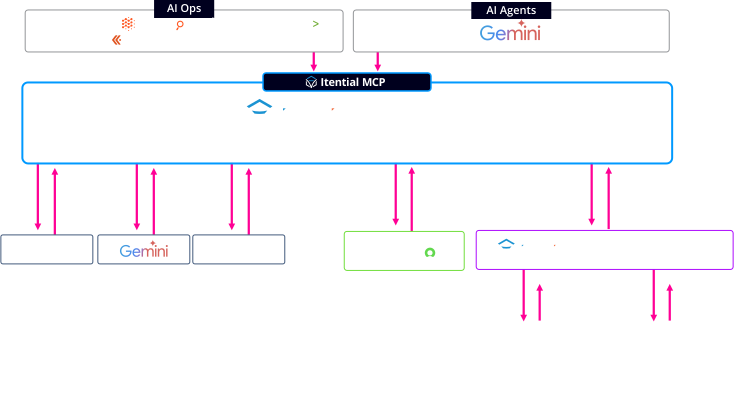
AI-driven orchestration with Itential refers to the platform's ability to connect your AI ecosystem (including LLMs, AIOps, and agents) to your infrastructure, transforming AI-generated insights into trusted, automated actions. Itential provides built-in guardrails, policy enforcement, and cross-domain orchestration, making AI operational at scale for network and infrastructure operations. Source
How does Itential bridge the gap between AI insights and infrastructure actions?
Itential acts as the secure execution layer that translates AI signals—such as LLM suggestions, AIOps alerts, or agent tasks—into automated, governed workflows across your network and infrastructure. This ensures that AI-generated recommendations are executed safely, with policy enforcement, approvals, and auditability. Source
What are the main capabilities of Itential's AI orchestration platform?
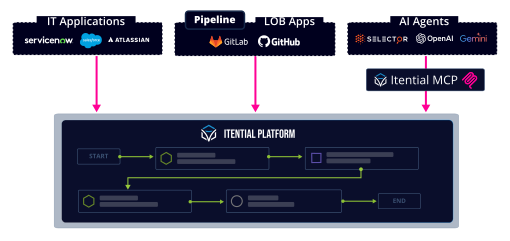
Key capabilities include AI-driven event detection and workflow initiation, secure policy-driven automation, multi-domain and multi-vendor orchestration, scalable AI-enabled network management, and agentic orchestration with the MCP Server. The platform supports embedding AI agents within workflows, agent-initiated workflow triggering, and automated remediation. Source
How does Itential ensure secure execution of AI-initiated actions?
Itential enforces strict guardrails on all AI-initiated actions, including policy enforcement, pre/post validation checks, role-based approvals, and comprehensive logging. This prevents unsafe or non-compliant changes from reaching production environments. Source
What is the Itential MCP Server and how does it support AI orchestration?
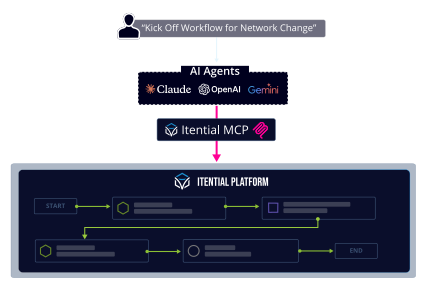
The Itential MCP Server is a governance layer that translates AI and external system outputs into structured, executable actions within the Itential platform. It ensures agent actions are contextual, traceable, and compliant, enabling secure agent-to-agent workflows with human oversight. Source
How does Itential support multi-domain and multi-vendor orchestration?
Itential is engineered to orchestrate across network, cloud, and IT domains, regardless of environment or vendor. This enables AI-driven workflows to operate seamlessly across hybrid and complex infrastructures. Source
Can Itential integrate with any AI platform or AIOps tool?
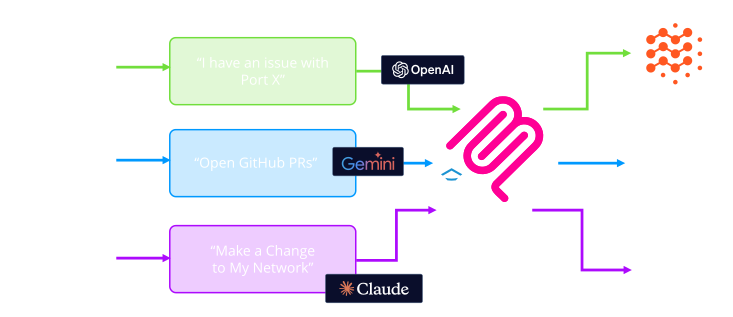
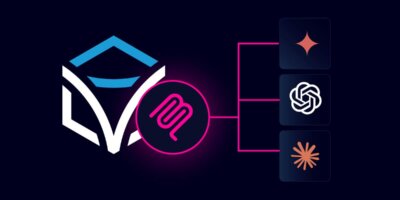
Yes, Itential is AI-agnostic and integrates with any LLM, custom agent, AIOps, or observability platform via APIs and webhooks. This allows AI tools like Gemini, ChatGPT, Claude, and Selector to initiate or enhance orchestration workflows. Source
What are the four modes of AI integration and orchestration with Itential?
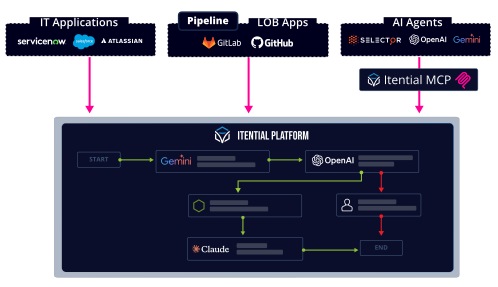
The four modes are: (1) AI-driven event detection and automated remediation, (2) AI agent-initiated workflow triggering, (3) embedding AI agents within workflows, and (4) agentic orchestration with the MCP Server. Each mode enables enterprises to harness AI for trusted, governed, and auditable outcomes. Source
How does Itential handle governance and auditability for AI-driven actions?
All AI-driven actions in Itential are logged with full traceability, including who or what initiated them, when, and the results. Policies define which actions require approvals, which can run automatically, and how evidence is stored for audits. Source
What is the risk of using AI directly without orchestration?
Using AI directly without orchestration can result in non-compliant, misaligned, or unsafe changes reaching production, potentially causing outages or compliance violations. Orchestration ensures that all AI-generated actions are validated, governed, and auditable. Source
Use Cases & Real-World Applications
What are common use cases for AI-driven orchestration with Itential?
Common use cases include incident resolution (AIOps detects issues, Itential automates fixes), compliance remediation (auto-correcting config drift), AI-augmented troubleshooting (LLMs analyze logs), agent collaboration (secure agent-to-agent workflows), ticket triage (AI identifies issues, Itential resolves tickets), and CI/CD automation (AI triggers builds and deployments). Source
How does Itential support AI-augmented troubleshooting?
Itential enables LLMs to analyze logs mid-workflow, providing recommendations and guiding faster resolutions. This integration allows for conditional branching and combines human input, automation, and AI reasoning in one flow. Source
How does Itential automate compliance remediation?
Itential auto-corrects configuration drift using approved, auditable workflows. AI detects non-compliance, and Itential executes remediation actions while maintaining full traceability and policy enforcement. Source
How does Itential enable agent collaboration in workflows?
The MCP Server allows secure agent-to-agent workflows with human oversight, ensuring that agent actions are governed, contextual, and compliant. This supports collaborative automation across teams and systems. Source
How does Itential support CI/CD automation with AI?
AI tools can trigger builds and deployments through Itential, streamlining DevOps pipelines and ensuring that all actions are governed and auditable. Source
Can AI agents initiate self-service requests through Itential?
Yes, AI agents can trigger workflows in Itential, but all actions are subject to role-based access control (RBAC), policies, validations, and audit logging, ensuring governance is maintained. Source
How quickly can enterprises adopt AI orchestration with Itential?
Enterprises typically see ROI within 3–6 months by starting with low-risk workflows (such as drift remediation or ticket enrichment) and expanding to more critical changes as guardrails are proven. Source
How does Itential support cross-domain orchestration when AI is involved?
AI outputs can trigger workflows that span network, cloud, and security domains. Itential ensures consistency across stacks and integrates with sources of truth to maintain accuracy. Source
Integrations & Extensibility
What integrations does Itential support for AI-driven orchestration?
Itential supports over 300 pre-built integrations, including ServiceNow, NetBox, Infoblox, GitHub, Selector AIOps, Kentik, Forward Networks, IP Fabric, Red Hat Ansible, Terraform, Slack, Microsoft Teams, Arista Networks, Cisco, F5, and Palo Alto. For a full list, visit the Automation Marketplace.
Why are integration and extensibility critical for an orchestration platform?
Orchestration is only as powerful as its integrations. Tight connectivity with ITSM, CMDB/SoT, observability, identity, IaC, APIs, and custom systems is essential for reducing friction and technical debt, enabling seamless automation across all infrastructure domains. Source
What is the role of API integration in workflow orchestration?
API integration allows the Itential platform to connect with and control various network devices, controllers, and IT systems, enabling end-to-end automated workflows that span multiple domains. Source
How does the Itential Platform solve the 'integration tax' of using multiple orchestrators?
The Itential Platform sits above domain-specific orchestrators, providing a federated API layer. This allows each system to be integrated once and reused across multiple automations, avoiding the manual effort and cost of point-to-point integrations. Source
Security, Compliance & Governance
What security and compliance certifications does Itential hold?
Itential holds SOC 2 Type II Certification, FIPS 140-2 compliance, and adheres to GDPR and CCPA for global data privacy. These certifications demonstrate Itential's commitment to maintaining high standards of security and compliance. Source
How does Itential automate compliance and auditability?
Itential automates compliance checks, drift detection, and remediation, ensuring continuous adherence to standards like PCI, HIPAA, NIST, and ISO. Every change is logged with comprehensive details for full traceability. Source
How does Itential support public sector and regulated industries?
Itential supports on-prem and air-gapped deployments, ensuring data remains within secure environments and enabling compliance with mandates like STIGs. The platform's built-in governance features are particularly beneficial for regulated industries. Source
What built-in governance features does Itential provide?
Itential includes role-based access control (RBAC), single sign-on (SSO), encryption for data in transit and at rest, approval workflows, and comprehensive audit logging to enforce compliance and security. Source
Implementation, Support & Getting Started
How long does it take to implement Itential and see value?
Itential's Professional Services help customers go from contract signature to a production-ready platform with active use cases in 3–6 months. Initial value is often seen within weeks, with rapid expansion of automation capabilities over 6–12 months. Source
What resources are available to help new users get started with Itential?
Resources include a structured onboarding program, a 6–8 week activation program, interactive product tours, training and certification via Itential Academy, comprehensive documentation, and access to Professional Services. Product Tours | Itential Academy | Documentation
Where can I find technical documentation for Itential?
Comprehensive technical documentation, API references, and release notes are available at docs.itential.com. API documentation is at apidocs.itential.com.
What support options does Itential offer?
Itential offers a customer portal, professional services, customer success programs, and access to a resource library, including demos, guides, and analyst reports. Customer Portal | Professional Services
Is there a way to try Itential before purchasing?
Yes, you can take interactive product tours and watch demo videos to experience Itential's capabilities firsthand. Product Tours | Demo Videos
Customer Success & Business Impact
What business impact can customers expect from using Itential?
Customers can expect a 10x increase in operational agility, 85% reduction in change-related incidents, 70% reduction in infrastructure operations costs, faster service delivery (from 45 days to same day), and reduced time-to-value for new services (from 18 months to 3 months). Source
What feedback have customers shared about Itential's ease of use?
Customers praise Itential's low-code design and intuitive interface. For example, Uzair Khan (Rush University Medical Center) highlighted the ability to create impactful automations without developer expertise, and Eric Anderson (Armstrong) reported saving over 21,000 hours of manual work. Source
What core problems does Itential solve for enterprises?
Itential addresses fragmented automation and tool sprawl, manual change execution, configuration drift, multi-domain complexity, inability to scale operations, lack of governance and auditability, and slow adoption of automation. Source
Who is the target audience for Itential's platform?
Itential is designed for cloud network engineers, NetOps teams, DevOps teams, infrastructure architects, compliance and SecOps teams, and is used across industries such as telecommunications, financial services, healthcare, manufacturing, public sector, utilities, media & entertainment, biotechnology, and energy. Source
Why should a customer choose Itential over other automation solutions?
Itential offers vendor-agnostic, multi-domain orchestration, low-code accessibility, 300+ pre-built integrations, compliance-native features, measurable business impact, and ease of use for both technical and non-technical users. Source
How does Itential differ from similar products in the market?
Itential stands out with its vendor-agnostic, multi-domain orchestration, low-code workflow builder, integration-first approach, compliance-native features, AI-ready design, and measurable business impact. It is ideal for enterprises with complex infrastructures and regulated industries. Source