


Platform Engineering
Incorporate platform engineering principles into infrastructure automation & orchestration.
Your Challenges
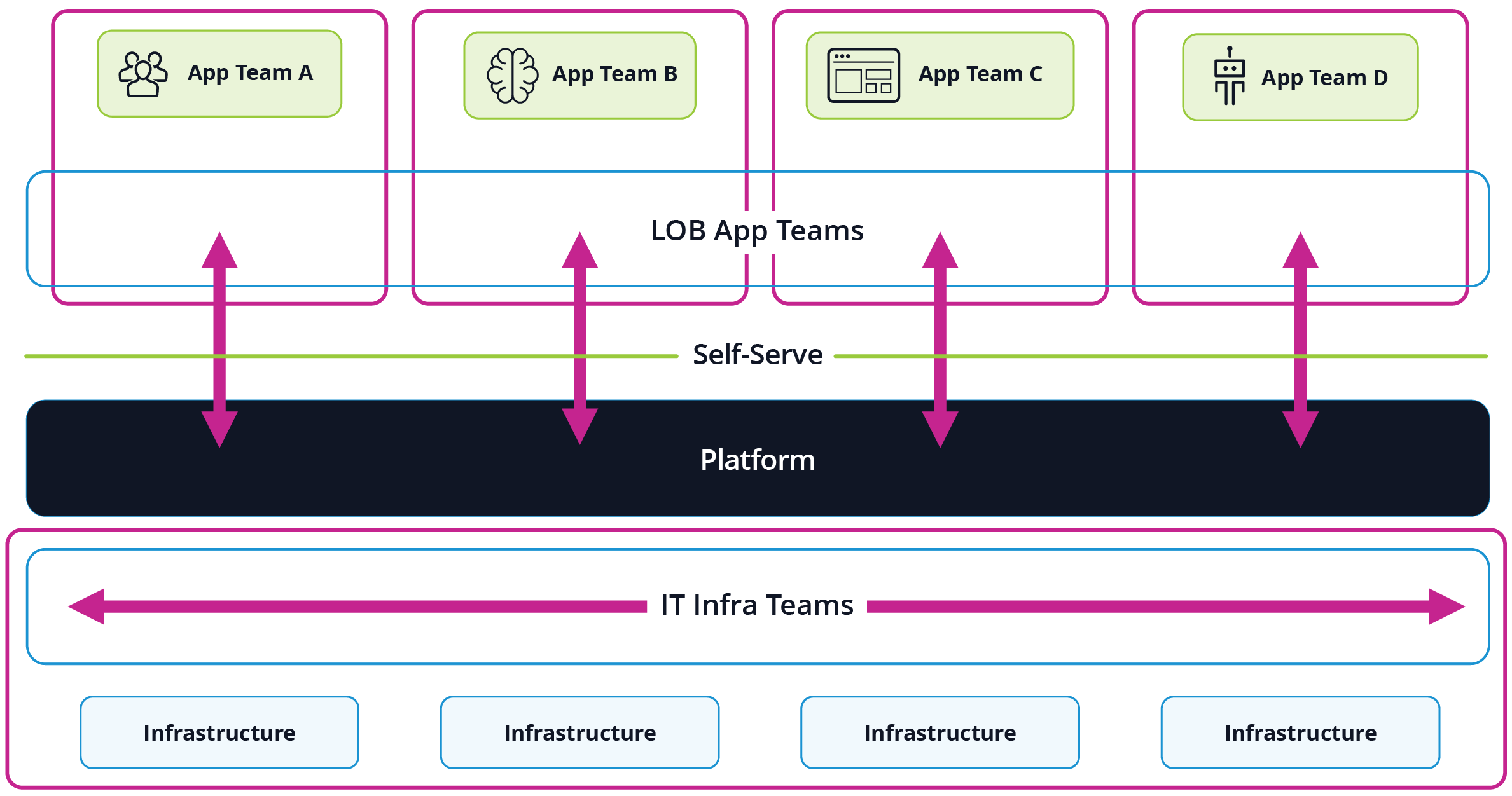
Application teams have become accustomed to the simplicity of requesting cloud services from the public cloud vendors and expect the same simplicity for requesting internal network and infrastructure services. By adopting a platform engineering approach, teams can reduce the friction across all IT teams – including development, network, security, compute, data management, etc. – by creating and exposing easy-to-consume infrastructure capabilities.
Lack of a centralized platform approach to infrastructure management leads to challenges such as:
- Fragmented architectures and management interfaces.
- Ticket and handoff-driven bottlenecks for service delivery, resulting in days or weeks to fulfill requests.
- Security, infrastructure, and applications teams operating in silos.
- Bespoke infrastructure services for different internal consumers, wasting network engineers’ time and effort.
- Difficulty leveraging traditional infrastructure alongside cloud infrastructure in a way that is scalable and efficient.
Delivering Infrastructure Platform Engineering Through Automation & Orchestration
The goal of platform engineering across infrastructure domains is not only to simplify infrastructure services available across all times, but also to speed up the deployment of applications and services by providing self-service capabilities where applications and infrastructure services that span complex infrastructure are easily consumed by end users.
Infrastructure platform engineering can help all IT teams manage the complexity of multi-vendor and non-standard infrastructure using low-code automation and orchestration to shield this complexity from end users. The DevOps teams, meanwhile, can build infrastructure services into a platform as part of a menu of services that end users can self-serve.
An automation and orchestration platform like Itential that provides integration and orchestration capabilities across all infrastructure (public clouds, private clouds, on-premises networks, etc.) is key to bringing infrastructure into an internal self-serve developer portal. This approach can accelerate automation efforts and help organizations make networking a vital part of a platform engineering strategy.
How Itential Supports Infrastructure Platform Engineering
The Itential Platform is based on a fundamentally unique approach to infrastructure orchestration. It is designed to enable IT, applications, and domain teams to collaborate on building and designing workflows for end-to-end orchestration of infrastructure deployment, provisioning, and management. Then, these orchestrated services can be delivered as self-service capabilities to end users via API endpoints so that they are accessible in internal platforms, ServiceNow environments, CI/CD pipelines, and more.
Low-Code Workflow Builder for Orchestrated Provisioning of Infrastructure Services & IT Applications
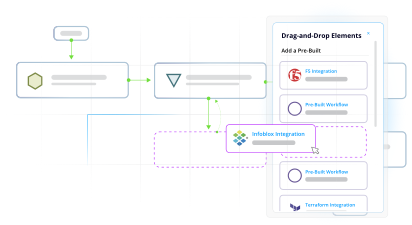
Itential’s workflow builder facilitates integrated orchestration by offering a low-code, abstracted interface to build end-to-end workflows. These workflows are built out of individual automated components – those components can be CLI-driven automations built with Python or Ansible, API calls to IT and network systems, and automated tasks pulled from vendor-specific point solutions in your environment. This means teams can leverage existing tools and domain knowledge without needing to learn a new automation toolset. As a result, any IT process can be orchestrated from start to finish, including access control, validation, and change management alongside any infrastructure changes.
Securely Expose Automations for Self-Service Consumption
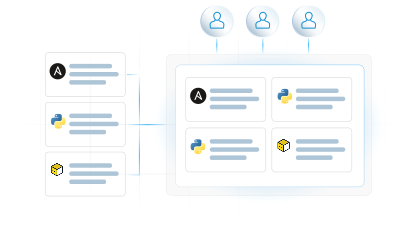
With Itential, infrastructure automation teams can expose workflows to end users, enable secure, scalable access to onboarded automation assets such as Python, Ansible, and Terraform, and provide secure access to API routes for any systems integrated with Itential.
Expose APIs to Programmatically Invoke Automation & Orchestration Capabilities
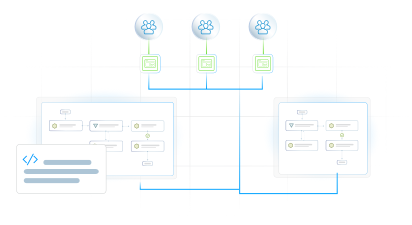
Itential’s powerful API-first capabilities can expose a range of actions to Platform Engineering teams to enable them to easily discover and incorporate orchestration and automation into their pipelines and applications.
Publish APIs for DevOps CI/CD Pipeline Integration
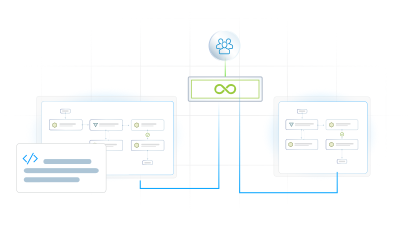
Itential provides two-way integration capabilities with CI/CD pipelines. Infrastructure teams can call pipelines to perform steps within an orchestrated workflow. DevOps teams can call infrastructure services published with Itential right from a pipeline via API endpoints. This enables DevOps and infrastructure teams to collaborate more efficiently regardless of infrastructure or service complexity. Operations teams can run workflows built and governed by domain experts – without needing to become experts across every infrastructure domain. For mature platform teams, this helps reduce how much infrastructure management logic lives inside CI/CD pipelines by shifting orchestration into a centralized platform layer.
Stateful Orchestration of Operational & Execution Data
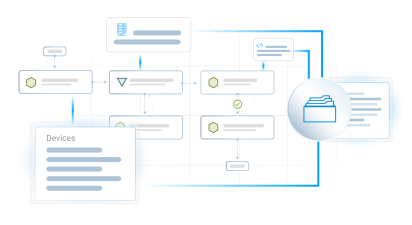
Itential provides stateful orchestration capabilities for organizations to leverage state data to manage complex infrastructure throughout service lifecycles. This is key to cost control in complex hybrid environments – without centralized state data available, organizations can easily spend unnecessary money on cloud or infrastructure resources. Stateful orchestration also enables operational lifecycle use cases such as remediation, patch management, and controlled environment migrations (e.g., Test → QA) by tracking execution context and outcomes over time.



Frequently Asked Questions
What does “platform engineering” mean in the context of infrastructure?
Platform engineering means packaging network and infrastructure capabilities into standardized, self-service offerings that application and IT teams can easily consume. Itential enables infra teams to act as “platform teams,” exposing governed services instead of fulfilling bespoke requests manually.
What problems does this solve for network and infrastructure teams?
It eliminates bespoke, one-off services, reduces bottlenecks, breaks down silos between security/app/infra teams, and provides a central platform approach for managing multi-vendor environments.
How does Itential make infrastructure consumable like cloud services?
Itential enables infrastructure teams to publish network services (VLANs, firewall rules, connectivity, load balancers) as reusable, low-code workflows that are exposed via self-service catalogs or APIs, similar to how public cloud providers deliver services.
How does this approach improve speed of service delivery?
With workflows packaged into a platform, requests that once took days or weeks to fulfill are delivered in minutes, accelerating application deployments and reducing friction between teams.
How do DevOps and application teams benefit from this?
They gain on-demand access to infrastructure services through APIs or portals, reducing reliance on tickets and manual coordination with network teams. This helps applications move faster without sacrificing governance.
How does Itential address the challenge of multi-vendor or hybrid infrastructure?
Itential abstracts complexity using low-code automation and orchestration, integrating across different vendor systems, legacy infra, and cloud platforms. This ensures platform services work consistently, regardless of the underlying infrastructure.
What security and governance controls are in place?
Every published service is wrapped with RBAC, policies, validations, and logging. This ensures services are delivered securely, consistently, and with full auditability.
What’s the difference between infrastructure platform engineering and legacy automation?
Legacy automation often results in silos of scripts and point solutions. Infrastructure platform engineering takes those automations, standardizes them, and exposes them as self-service, governed offerings that scale across the enterprise.
What are some common platform services infra teams can expose with Itential?
Examples include network connectivity (VLANs, VPNs), firewall and security policy changes, DNS/IPAM services, load balancers, and hybrid cloud connectivity.
Learn More with Itential Content


Blogs

- Taking On Platform Engineering for Networking, One Step at a Time
- Evolving the Operational Mindset to Enable Self-Service Networking
- How Security, Application, & Network Teams Can Reap the Rewards of a Centralized Orchestration Platform
- NetDevOps, Self-Service, & Evolving the Network Change Process to be Consumable by Everyone
- Building Scalable Systems to Evolve from Automation to Orchestration for a FinTech Network
- Gartner® Hype Cycle for I&O Automation Highlights Shift Towards “Automation-First” & Need for Broader Orchestration
Other Resources
- How a Global Pharmaceutical & Medical Technologies Company Built a Center of Excellence to Foster an Automation-First Culture with Itential
- How To Create & Deploy New Applications by Integrating CI/CD with Network Change Processes
- How to Connect ServiceNow to Your Infrastructure with Itential
- How to Publish & Expose Network Automations as a Service with Itential
- The Rise of NetDevOps & The Shift Left for Networking
- Enabling NetDevOps Through CI/CD Pipeline Integration with Itential